The Complete Guide to Sculpture: Scale, Material, and How Long It Actually Lasts
Scale, material, and site decide almost everything about a sculpture before a single tool touches the material. Here's the complete guide — from defining what "large-scale" even means to why some materials outlast the civilizations that made them.
Ask what separates a garden statue from a public monument and most people reach for size first, which is only part of the real answer. Scale, material, and site each make separate, largely independent decisions about what a sculpture actually is — a small bronze can be more permanent than a monumental one, and a piece built for a plaza fails completely if it's simply enlarged from a maquette without rethinking how a body actually moves around it. This is the complete guide to those decisions, in the order a sculptor or a commissioning institution actually has to make them.
At a glance
| Question | What actually decides it |
|---|---|
| Is it "life-size," "large-scale," or "monumental"? | Ratio to the human body, not a fixed measurement |
| How long will it actually last? | Material and site environment, far more than budget |
| Why does bronze dominate public sculpture? | A patina that protects rather than damages |
| Why do realistic figures sometimes unsettle people? | The uncanny valley, still not fully explained |
| What makes work "site-specific" rather than just placed? | Whether moving it would change what it means |
Defining scale: it's a ratio, not a measurement
"Life-size," "large-scale," and "monumental" get used almost interchangeably in casual conversation, but each one is answering a genuinely different question about a sculpture's relationship to the body looking at it. A life-size sculpture sits at exactly human proportion, and that precision is exactly what makes the category psychologically loaded rather than neutral — a figure at 1:1 scale invites the viewer's own body as the reference point for judging it, which is why realistic life-size work can unsettle people in a way smaller or larger figures rarely do. Large-scale sculpture breaks that intimate comparison deliberately, exceeding human proportion enough that the work reads as environment rather than encounter — the Statue of Liberty and Mount Rushmore both work by removing any plausible sense that a human body could be the measure of them at all. Monumental work pushes further still, often built specifically to be glimpsed at speed and distance rather than studied up close, the way Antony Gormley's Angel of the North was designed for drivers rather than pedestrians.
Scale at the largest end has always carried a specific political charge worth naming directly: colossal statuary — from Rhodes's lost bronze Colossus to Egypt's pharaonic monuments to the carved presidential faces of Mount Rushmore — has been used across entirely unrelated civilizations to assert a ruler's or a nation's power precisely because overwhelming physical size communicates authority faster and more viscerally than any inscription could. A figure large enough that a viewer cannot take it in from a single glance is making an argument about permanence and dominance before a single detail of its subject matter registers at all, which is part of why the largest sculptures in human history are disproportionately monuments to rulers, gods, and nations rather than to anything more modest — a tradition still very much alive today in the Statue of Unity in Gujarat, India, completed in 2018 at roughly 182 meters and currently the tallest statue on earth, dwarfing the Statue of Liberty by a factor of more than three.
Advertisement
Why some realistic figures feel wrong
Scale interacts with realism in one specific, well-documented way that's worth understanding before committing to either. The uncanny valley describes how comfort with a human representation rises with realism only up to a point, then drops sharply just short of true likeness before recovering, in theory, once realism becomes indistinguishable from the real thing — first proposed by the roboticist Masahiro Mori in 1970, and independently rediscovered by sculptors for two centuries before he named it. Duane Hanson's hyperrealist figures from the 1970s exploited the valley deliberately, cast directly from real people down to their clothing; Antony Gormley's cast-iron figures at Crosby Beach avoid it just as deliberately, staying stylized enough that they read as a crowd of witnesses rather than something uncomfortably almost-alive. Neither approach is more correct — they're opposite strategies for the same well-documented terrain, and knowing it exists is most of what lets a sculptor navigate it on purpose rather than stumbling into it.
The three families of technique: carve, model, assemble
Every sculptural process, regardless of the era or material, falls into one of three fundamentally different physical relationships between the artist and the material — and each carries its own risks, its own tools, and its own philosophy about how a form actually comes into being.
Carving is subtractive: the sculptor removes material from a solid block, and every cut is permanent, which is exactly why direct stone or wood carving has always demanded a different kind of planning discipline than the other two families. Modeling is additive and reversible while wet: clay, wax, and similar materials can be built up, reworked, and corrected freely, right up until the moment the sculptor commits to casting or firing the result, which is why modeling has historically been the default technique for anything that needed to go through a mold on its way to a more permanent material. Assemblage and construction, the newest of the three families in any organized sense, joins pre-existing or fabricated elements — welded steel, found objects, cast components — together into a single work, treating the sculpture as an act of combination rather than removal or addition, and it only became a widespread serious practice once affordable, portable arc welding equipment made steel-jointing accessible outside an industrial factory setting.
Michelangelo, working almost exclusively by direct carving, described his own process as freeing a figure already latent inside the block of marble rather than imposing a form onto inert stone from outside — a philosophy that treated the carving process as discovery rather than pure invention, and one visible literally in his unfinished Prigioni (Slaves), where partially carved figures still appear to be emerging from the surrounding rock. That same non-finito, or deliberately unfinished, quality became its own recognized aesthetic rather than simply an interrupted commission, prized specifically for showing the process a fully polished, completed work conceals entirely.
Stone and wood: the discipline of no second chances
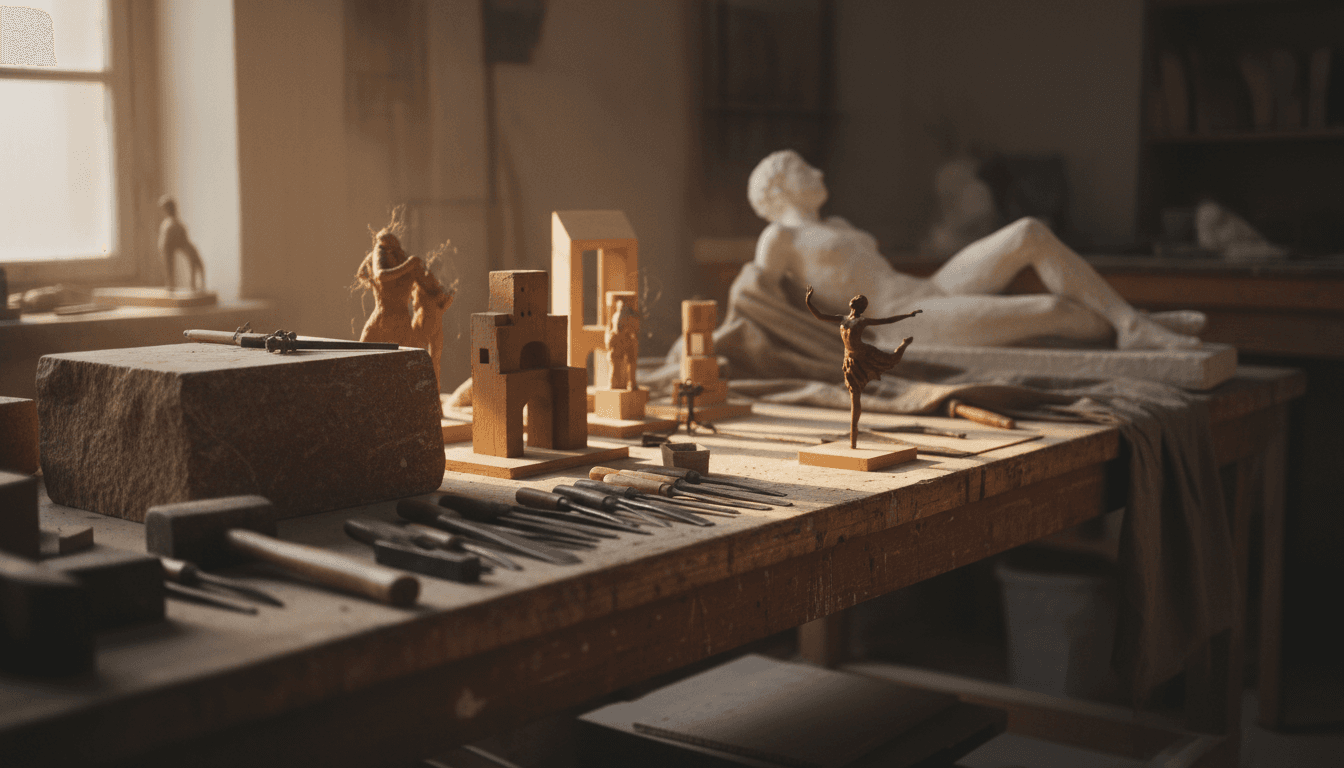
Direct carving in stone or wood offers no undo, which makes it the most conceptually demanding of the three technique families: every strike of a mallet against a chisel is a decision that can't be reversed, and a sculptor working this way has to plan considerably further ahead than either modeling or assemblage requires. The basic toolkit has changed remarkably little across centuries — a point chisel for rough removal of large volumes, a claw or tooth chisel for defining intermediate forms, flat chisels for finishing surfaces, and abrasives for the final polish — and the sequence, roughing out before refining, refining before finishing, remains essentially the same discipline Michelangelo would recognize.
Reproducing a finished sculpture at a different scale, or duplicating it in a different material entirely, historically relied on a mechanical device called a pointing machine: a frame with adjustable, calibrated points that transfers precise measurements from an original model onto a new block, letting assistants rough out a faithful copy before the master sculptor finished the surface personally — a workshop division of labor with real parallels to how a painting workshop divided its own labor along similarly practical lines. The device let sculptors like Auguste Rodin's own studio scale up small clay or plaster originals into monumental marble or bronze versions without the master personally carving every cubic inch of the final, much larger stone.
Modeling: building a form the material can still forgive
Where carving commits, modeling negotiates. A sculptor working in clay builds a form over an internal skeleton called an armature — typically a welded or bent metal frame, sometimes wrapped in wire mesh or wadded material to bulk out large masses cheaply before the clay itself goes on — which does the structural work of holding an ambitious pose upright while the clay is still wet and has no strength of its own. Water-based clay stays fully workable for as long as it's kept damp, and can be scraped away, added back, or reshaped entirely at any stage before the sculptor is satisfied, which is precisely the reversibility carving can never offer; the trade-off is that unfired clay is fragile and temporary, useless as a final material and valuable only as a stage toward a mold, a firing, or a cast.
Advertisement
Wax modeling solves a different problem specific to bronze casting: because lost-wax casting requires an intermediate wax positive of the final form regardless of what the finished piece will be made of, sculptors developed working methods specifically suited to wax's particular behavior — its ability to be melted and reworked with heated tools, its sensitivity to ambient temperature changing how firm or soft it feels in the hand, and its usefulness for the fine surface detail a subsequent bronze pour will faithfully reproduce down to a fingerprint left in the wax by accident. Plaster occupies a further, distinct role: cast from a clay or wax original, a plaster intermediate is durable enough to survive handling, molding, and the pointing-machine process described above, serving as the archival, semi-permanent record of a design between the fragile working original and whatever final material — bronze, marble, a modern polymer — the finished commission actually requires.
Assemblage: sculpture as combination rather than removal or addition
Assemblage broke from both older families by treating the sculptural act as selection and joining rather than carving away or building up a single continuous mass. Pablo Picasso's early constructed sculptures and, more directly, Marcel Duchamp's readymades — ordinary manufactured objects presented as art with minimal or no alteration — established the conceptual groundwork: that a sculpture's meaning could come from the relationship between combined elements, or even from the simple act of selection and recontextualization, rather than exclusively from the sculptor's own hand shaping raw material. David Smith, working through the middle of the twentieth century, brought industrial welding technique directly into fine-art sculpture, building large-scale steel works from his own background in factory metalwork and treating a welding torch as legitimately as any chisel or modeling tool that came before it.
Arc welding, the technique underlying most metal assemblage, uses an electrical arc to melt and fuse metal at the joint, and different processes within that broad category — MIG welding's continuous feed wire suits fast, high-volume joining; TIG welding's more controlled, precise arc suits fine detail and thinner materials — give a sculptor working in steel roughly the same range of mark-making choices a painter has between a broad brush and a fine one. Unlike carving or modeling, assemblage carries no inherent size limit tied to a single block of raw material, since a large welded work is simply built from more individual pieces joined together, which is part of why so much of the largest contemporary metal sculpture is assembled rather than cast or carved as one continuous form.
Modern casting beyond bronze
Bronze earned its historical dominance for genuine chemical reasons covered further down, but it isn't the only metal a foundry can pour, and contemporary sculpture increasingly weighs real alternatives against it.
Cast aluminum offers a dramatically lighter, cheaper alternative that resists corrosion through its own stable oxide layer rather than a patina, making it attractive for large or transportable work where weight and budget both matter more than bronze's specific historical prestige. Fabricated stainless steel, built up from welded plate rather than poured from a mold at all, trades the organic, slightly irregular surface of a cast piece for crisp, geometric precision and near-total corrosion resistance, which is part of why so much large-scale contemporary public sculpture — the polished, mirror-finish work associated with artists like Anish Kapoor — is welded and ground stainless steel rather than cast bronze at all.
Choosing a material: what each one actually trades off
| Material | Best for | Main trade-off |
|---|---|---|
| Bronze | Figurative and traditional public work | Highest cost and weight; needs chloride-free siting |
| Marble/granite | Carved work meant to last centuries | Heavy, expensive, slow to work, brittle under impact |
| Aluminum | Large or transportable work on a budget | Lower prestige perception; softer than steel or bronze |
| Stainless steel | Crisp, geometric, mirror-finish contemporary work | Fabrication and polishing labor can rival casting cost |
Each material is solving the same underlying problem — durability, cost, and buildability at scale — with a genuinely different set of trade-offs, and the choice is now a real, informed decision rather than a default driven by tradition alone.
Kinetic and temporary work: when impermanence is the point
Not every sculptural tradition treats permanence as the goal, and deliberately impermanent or moving work forms its own coherent category rather than a lesser version of the durable, site-anchored sculpture discussed elsewhere in this guide. Kinetic sculpture, work that incorporates real physical movement, ranges from Alexander Calder's wind-driven mobiles — objects balanced so precisely that ordinary air currents set their component shapes drifting and rotating in a constantly changing composition — to George Rickey's later, similarly wind-responsive stainless steel forms, both treating unpredictability itself as a compositional element no static sculpture can replicate. Ice sculpture and sand sculpture push the same logic to its natural conclusion: the work's scheduled disappearance isn't a failure of the material, it's the explicit premise the entire piece is built around, and documenting the work thoroughly before it melts or erodes becomes, in a real sense, the actual long-term artifact the sculpture leaves behind.
Commissioning a public work: how the process actually runs
Public sculpture commissions follow a broadly consistent institutional sequence, whether the commissioning body is a city government, a corporation, or a private foundation. A request for proposals typically opens the process, specifying the site, an available budget range, and any thematic or programmatic requirements the eventual work needs to satisfy; interested artists respond with a written proposal and, often, a small-scale maquette — a scaled model demonstrating the proposed work's form, material, and relationship to its intended site well before any full-size fabrication begins. Selection committees for public work frequently include a formal public input stage, since a permanent piece installed in a shared civic space raises different stakeholder questions than a private commission for an individual client ever does, and community reaction to a proposed public work — sometimes supportive, sometimes fiercely contested — has become an expected, planned-for part of the modern commissioning timeline rather than an unwelcome surprise late in the process.
Advertisement
Budget for public sculpture varies enormously by material, scale, and site complexity, but fabrication, engineering, site preparation, and installation typically account for a larger share of total cost than the artist's own design fee — a genuine surprise to first-time public commissioners who assume the visible artwork itself represents most of what they're actually paying for. Structural engineering sign-off, particularly for anything large-scale or sited where public safety is a direct concern, has become a standard, non-negotiable stage of the process precisely because a monumental work that fails structurally is a public liability in a way a gallery piece never has to account for.
Material decides how long any of this actually lasts
Scale and realism are aesthetic decisions; material is where a sculpture's actual lifespan gets set, often for reasons that have nothing to do with the sculptor's intent. Granite sits close to inert, failing only through slow physical erosion measured in centuries; bronze can last two hundred years or more, provided chlorides from coastal air or de-icing salt don't trigger a self-sustaining corrosion called bronze disease; stainless and weathering steel occupy a middle tier, durable for a human lifetime or more but genuinely dependent on drainage and detailing; concrete and fiberglass sit at the fragile end, typically failing within twenty to fifty years as reinforcing steel corrodes or UV breaks down resin. None of these figures are fixed constants — they shift dramatically with the specific site, and a material rated for centuries inland can fail in decades near the coast.
Why bronze became public sculpture's default material
Bronze's dominance in outdoor and public work traces back to one specific piece of chemistry rather than tradition alone. The casting process itself — lost-wax modeling, an investment shell, a molten pour, and finally a deliberately applied patina — leaves the metal covered in a layer of copper carbonates and sulfates that isn't decay at all, but a stable mineral crust that slows further corrosion to a near-standstill. That's the reason a bronze figure installed today can plausibly outlast the institution that commissioned it, and also the reason the Statue of Liberty's real vulnerability turned out to be its hidden iron armature rather than its visible copper skin — two different metals in contact, with moisture present, corrode the less noble one first, a failure mode invisible from the outside until it was almost too late.
Siting an outdoor work correctly from the start
Choosing to place any sculpture outdoors at all, regardless of the specific material chosen, commits a piece to a genuinely different design brief than an interior work ever faces. An outdoor sculpture has to withstand water, ultraviolet exposure, and repeated temperature cycling all at once, rather than any single threat in isolation, and the vast majority of outdoor sculpture failures trace back to just a few preventable design decisions: a form or crevice that collects standing water rather than shedding it, dissimilar metals joined without any isolating barrier between them, or fixings and anchor points sized for convenience rather than for the actual structural load and inspection access they'll need over decades of service. Siting decisions made before a single tool touches the material — orientation to prevailing sun and wind, drainage at the base, distance from coastal salt spray or de-icing chemicals — do more to determine a piece's real-world lifespan than the specific alloy or stone grade selected, which is exactly why the site survey belongs at the start of a commission rather than as a formality once a design is already finished.
How conservators assess and maintain sculpture over time
Sculpture conservation runs on a different diagnostic logic than painting conservation, because the failure modes themselves are different: rather than layered paint films cracking or a varnish yellowing, an outdoor sculpture's condition assessment centers on corrosion depth and pattern on metal work, biological growth and staining on stone, and structural integrity at the joints and anchor points that carry the work's actual physical load. A condition survey typically documents the piece photographically at set intervals, tests any visible corrosion or efflorescence (the powdery mineral deposits that indicate moisture moving through stone or plaster), and inspects anchor points and structural welds directly for the kind of hidden deterioration that, as the Statue of Liberty's iron armature demonstrated, can fail decades before any external sign becomes visible. Routine maintenance — periodic washing to remove pollutants and biological growth, reapplication of protective coatings on metal, and prompt attention to drainage problems the moment they appear — is dramatically cheaper than the structural intervention required once a preventable problem has been left to compound for years, which is precisely why a maintenance budget belongs in the original commission rather than being negotiated separately once the work is already installed and any warranty period has expired.
Building for a specific site, not just a specific size
Once scale, realism, and material are settled, the remaining question is whether a piece is actually built for where it's going to stand, or simply placed there. Site-specific work is defined by a single, testable question: would the piece work equally well in three other locations? If yes, it's portable sculpture sitting in an interesting spot, whatever the wall text claims. Genuine site-specific design starts with a week or more of pure observation before any design decision gets made — reading the architecture, the light through the day, the traffic patterns, and the institutional constraints of budget and permitting — because a viewer doesn't experience installation from one fixed point the way they experience a painting; they enter, walk, and leave, and that whole sequence is the actual composition.
Advertisement
A commissioning and care checklist
- Decide the scale relationship deliberately. Life-size invites intimate comparison; large-scale and monumental trade that intimacy for environmental presence — pick based on the actual site and viewing distance, not habit.
- Choose the technique family — carve, model, or assemble — for what the concept actually needs, not by default; each carries a different tolerance for revision and a different relationship between the artist's hand and the finished surface.
- Match material to the real site conditions, not the regional average climate. Coastal air, de-icing salt, and freeze-thaw cycling all shorten a material's realistic lifespan dramatically.
- Design drainage and dissimilar-metal isolation from the start. Water traps and galvanic corrosion between metals cause more failures than any single material choice.
- If the work claims to be site-specific, actually test it against the site before finalizing a design — the three-other-rooms question is a genuine filter, not a rhetorical one.
- Budget realistically for fabrication and engineering, not just the design fee. Structural sign-off is a standard stage for large-scale public work, not an optional extra.
- Budget for a real maintenance schedule, not just installation. Annual inspection and periodic cleaning are what separate a piece that lasts its rated lifespan from one that fails early.
- Plan documentation as part of the commission, not an afterthought — most of a public work's eventual audience will encounter it as a photograph, never in person.
FAQ
What's the actual difference between "large-scale" and "monumental" sculpture?
Large-scale exceeds human proportion enough to read as environment rather than a life-sized encounter; monumental pushes further still, often designed specifically to be seen at speed and distance rather than studied up close.
Why does bronze last so much longer outdoors than most other materials?
Its patina is a stable, protective mineral crust rather than ongoing decay — the metal actively slows its own corrosion once that layer forms, provided chlorides from coastal air or road salt don't disrupt it.
What is the uncanny valley, and does it have a settled explanation?
It's the sharp dip in comfort that occurs just short of true human realism in a figure — first proposed in 1970, still without full scientific consensus on its exact cause, though its practical effects are well documented and reliably reproducible.
How do I know if a proposed sculpture is genuinely site-specific?
Ask whether the same design would work equally well in three other locations. If the answer is yes, it's portable work regardless of how it's described.
What actually causes most outdoor sculpture failures?
Water finding somewhere to collect, and dissimilar metals corroding each other through galvanic contact — both are design and detailing failures, not simply material or budget limitations.
What's the real difference between carving, modeling, and assemblage?
Carving is subtractive and irreversible, working from a solid block; modeling is additive and fully reversible while the material stays wet, like clay or wax; assemblage joins pre-existing or fabricated elements together, most often through welding, treating combination itself as the sculptural act.
What is a pointing machine, and what is it used for?
It's a mechanical device using calibrated, adjustable points to transfer exact measurements from a small model onto a larger block, letting assistants rough out an accurate enlarged copy before the master sculptor finishes the surface personally — the historical method behind scaling up a maquette into a monumental final work.
Why would a sculptor choose aluminum or stainless steel over bronze?
Aluminum is far lighter and cheaper and resists corrosion through its own natural oxide layer; welded stainless steel offers a crisp, geometric, mirror-polish surface cast bronze can't easily achieve. Both trade bronze's specific historical prestige for genuine practical advantages in weight, cost, or finish.
What is the tallest sculpture in the world today?
The Statue of Unity in Gujarat, India, completed in 2018 at roughly 182 meters, a scale that dwarfs the Statue of Liberty and exists specifically to make a statement about the historical figure it depicts rather than to be studied up close like a smaller portrait bust would be.
How do conservators actually check on an outdoor sculpture's condition?
Regular photographic condition surveys, corrosion and efflorescence testing, and direct inspection of structural joints and anchor points, since hidden failures at fixings and welds, not visible surface damage, cause most serious sculpture failures before any external warning sign appears.
The bottom line
Scale, technique, material, and site aren't four separate checklists to satisfy in sequence — they're four constraints that argue with each other from the very first sketch, and a successful commission is really just the record of how those arguments got resolved. A sculptor who chooses monumental scale has already committed to a different viewing experience than one working life-size; a choice between carving and casting has already decided how much revision is even possible once work begins; and a material chosen for its historical prestige rather than its actual site conditions is a decision that will announce itself, one way or another, decades after everyone involved in commissioning it has moved on.