Madder: The Red Root That Dyed the Bayeux Tapestry
On 16 August 1914, with the French infantry already in the field in red trousers, the war minister chose a new cloth and dropped its red thread, because the dye was German. The root behind that red had dyed the Bayeux Tapestry.
On 16 August 1914, with the French infantry already in the field in red trousers, samples of a new cloth reached Paris from a mill at Châteauroux, and the war minister, Adolphe Messimy, chose the one the army would wear instead. It was a blued steel grey brightened with light-blue and white fibres. It was not the cloth the High Council of War had voted for that May, which was to be woven from blue, white and red wool. The red had been dropped. According to Wikipedia's account of the cloth, one of two factors that sank the tricolour design was "the lack of alizarin, the synthetic madder dye manufactured in Germany, among others, by BASF".
The irony was exact. The trousers the army was retiring had been adopted on 26 July 1829 to encourage French madder growers, and the red it could no longer get for a new cloth was the synthetic copy of what those growers dug out of the ground. Every link in that sentence runs back to one root. Madder (Rubia tinctorum) dyed cotton at Mohenjo-daro in the third millennium BCE and wool for the Bayeux Tapestry in the eleventh century, and for almost the whole of the nineteenth century it was the main activity of the economy of the Vaucluse, the French département around Avignon. Then, in 1868, two German chemists found a way to make its colourant from anthracene, a hydrocarbon that can be extracted from coal tar, and a crop that had lasted more than four thousand years was effectively finished within a generation. This is the history of that root: how it dyes, who grew it, why its paint faded, why an army wore it, and how the Tapestry it coloured came to be mended, in the very years the laboratory caught up with it, with synthetic dyes.
Antiquity to Charlemagne: the everyday red
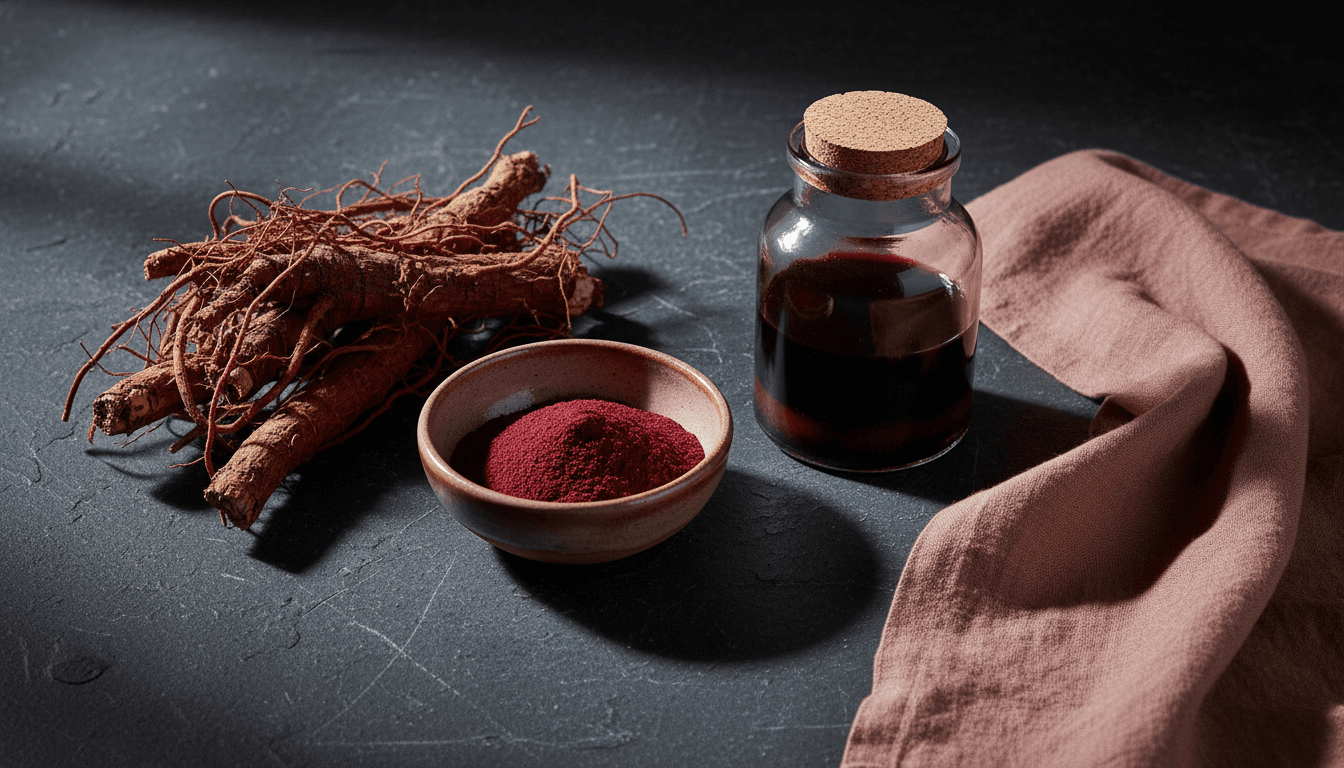
Madder does its work underground. For dye production the roots are harvested after two years, according to Wikipedia's entry on the plant, and they can be over a metre long and up to 12 millimetres thick. Inside them is a compound called ruberythric acid, which breaks down into sugars, alizarin and purpurin when the root is dried, fermented or treated with acid. Alizarin is the main red. To make the colour hold, the dyer fixes it to the fibre with a mordant — a metal salt, most commonly alum.
Advertisement
The record is long. A piece of cotton dyed with madder has been recovered from Mohenjo-daro, in the Indus valley, and dates to the third millennium BCE. Dioscorides and Pliny the Elder both mention the plant, which the Romans called rubia passiva. Charlemagne's Capitulare de villis, the text that guided the running of his royal estates and is dated to between 771 and 800, lists it as warentiam, and in the twelfth century Hildegard of Bingen's herbal mentions it too. Madder's strength was that it was ordinary. Cochineal, the insect red in Cochineal: The Insect That Made Red, wouldn't reach Europe from the Americas for nearly five centuries after the Bayeux Tapestry was made; until then, and for a long time after, the continent's red was a root that farmers could grow at home.
The eleventh century: ten colours, three plants
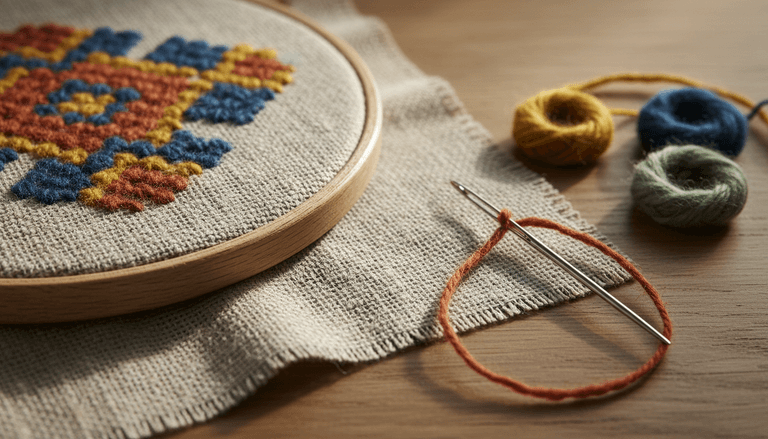
The Bayeux Tapestry is worked in wool thread on a coarse linen ground, using four stitches and ten natural dye colours. When small wool samples were tested by thin-layer chromatography in the 1980s, Chemistry World reports, the ten colours came down to three dye sources: "madders, a group of red dyes from anthraquinone compounds", weld for the yellows, and woad or indigo for the blue. The greens combine weld's yellow with a blue. The blue half of that partnership has its own history in Woad vs. Indigo: The Blue Dye Wars.
The yellow half has aged unevenly. Flavonoids, the chemical family of weld's yellow, fade faster than indigo, so the Tapestry's greens now look bluer than they once did, and Clémentine Paquier-Berthelot, head of exhibitions at the Bayeux Tapestry Museum, says the blues "have turned green". Even so, the Bayeux Museum's assessment, reported in our guide to the British Museum show, is that the original colours have changed little in almost a thousand years. The cloth's problem is its repairs, and they belong to the 1860s.
1466 to 1862: madder in paint
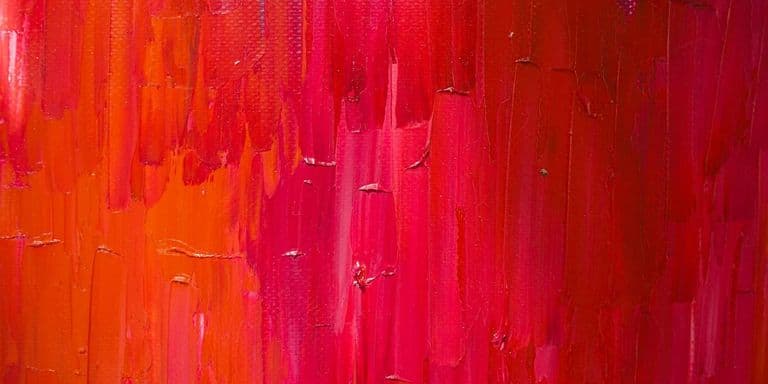
A dyer fixes madder to cloth; a painter needs it as a powder. The bridge between the two is the lake, a pigment made by fixing a dye onto a mineral base. According to Eclectic Light's article on crimson, madder and alizarin, someone discovered that aluminium salts would combine with the colourants in madder extract. The result was madder lake, which covered "a broad range of hues from pale purples through pinks to brilliant scarlet". Cochineal went into lakes too. Madder lake's record in paint is mixed, and the article's own examples show both sides.
| Painting | Date | What the article says of its red |
|---|---|---|
| Friedrich Herlin, High Altar | 1466 | Its abundant reds "seem to have stood the test of time"; the altar was normally stored with its wings closed |
| Workshop of the Master of the Life of the Virgin, The Mass of Saint Hubert | c. 1485–90 | Has "retained its deep reds from Madder Lake" |
| Altobello Melone, Christ Carrying the Cross | c. 1515 | Madder red mixed with a little lead-tin yellow, at least in the sleeve |
| Niklaus Manuel, Demons Tormenting St. Anthony | 1520 | Several reds, at least one mainly madder lake; "some of those reds may have faded", and St Anthony's cloak looks pale |
| Johannes Vermeer, Christ in the House of Martha and Mary | c. 1654–56 | Cited as "a good example of the use of Madder Lake by one of the Dutch Masters" |
| Fantin-Latour, Still Life with Chrysanthemums | 1862 | Reds the author suspects "owe much of their colour to partially-purified Alizarin Crimson" derived from madder root |
The pattern is not tidy. Herlin's altarpiece was normally stored with its wings closed, the article notes, which limited the light reaching its madder lakes. The wider verdict is that madder lakes were "not lightfast, even when protected in an oil paint film", and that many faded within months or a few years. Early lakes were weak to begin with. In 1804, Wikipedia's rose madder entry says, the English dye maker George Field refined the technique by "treating it with alum and an alkali", and before that most lakes were "relatively weak and extremely fugitive". Even Field's lakes carried a flaw inherited from the root: madder lake holds two dyes, alizarin and purpurin, and purpurin is "the more rapidly fading" of the pair. The entry's conclusion is that genuine rose madder is "too fugitive for professional artistic use".
Alizarin was isolated in impure form in 1826, which made rose-red alizarin lakes available, and it became a pigment in its own right from 1891. Fantin-Latour's chrysanthemums of 1862, the article suspects, already owe much of their colour to partly purified alizarin from madder root. Eclectic Light describes the crimson used by Vermeer, and by Turner "extensively", as fugitive.
The seventeenth and eighteenth centuries: Zeeland to Avignon
Behind every tube of madder lake was a farm. The crop needed two to three years in the ground before harvest, and its roots, the Dutch heritage site Zeeuwse Ankers says, are sometimes 70 centimetres deep, so a field of madder was a long bet. It was already grown in Zeeland in the Middle Ages, but not until the seventeenth century, when grain prices plummeted, did farmers there, especially on Schouwen-Duiveland and Tholen, dedicate themselves to dyer's madder. Kilns dried the roots. The finest grade was a light yellow powder, and it was the most expensive; in Zierikzee madder was inspected on the scales of the town hall. The result, the site says, was that textiles in the whole of Northwest Europe were given "a gorgeous red colour".
The most elaborate madder red was Turkey red, a strong, very fast dye for cotton that had been developed in India and spread to Turkey. Greek workers familiar with its methods were brought to France in 1747. (The multistep recipe, set out in the FAQ below, called for calf's blood and sheep's dung.)
Advertisement
France's madder country was the Vaucluse, and its founding figure, in the telling, was a man who arrived there after escaping slavery. Wikipedia's account of Jean Althen says he was born Hovhannès Althounian in 1709 in a village in the Safavid Empire that he called Chaouch. Enslaved and taken to Kayseri, he learned cotton cultivation and dyeing there. Around 1736 he escaped and reached France. His efforts to grow cotton came to nothing; in 1754, the entry says, he began cultivating "Oriental madder" in Avignon, with great success. With a local landlord he produced a crop of 2,500 kilograms in 1769. He died in poverty in 1774. A statue went up in Avignon in 1846, and the commune of Althen-des-Paluds is named after him.
The record is less tidy than the legend. A French Ministry of Culture dossier on one local madder mill, the Les Gaffins factory at Althen-des-Paluds, dates the start of madder-powder production in the Comtat, the country around Avignon, to 1756 and never mentions Althen. What it does establish is the scale of what followed: madder powder became the main activity of the Vaucluse's economy for nearly the whole of the nineteenth century, which made the département, in the dossier's words, "le premier producteur mondial de ce principe colorant" — the world's leading producer of the colourant. The industry improved as it grew. The Weinum patent of 1801 improved the drying of the roots, which had been spoiled when producers dried them over combustion smoke; the Gaffins mill, attested in 1812, had drying stoves, a grinding mill and a building with six millstones by 1820. Madder and silkworm rearing, the département's Atlas des paysages notes, reached their peak in the 1850s and 1860s.
1829: a uniform as farm policy
The French state had its own reasons to keep the crop alive. The infantry had worn a dark-blue coat since 1793; Odile Roynette, writing in Clio, says it then took up "du pantalon garance à partir de 1829" — madder trousers, from 1829. Wikipedia's article on the red trousers dates the decision to 26 July 1829 and gives the purpose as encouraging the rose madder dye-growing industry in France. The explanation was standard by 1919, when the Paris newspaper Excelsior ran a feature on soldiers' dress since the Empire. The red trousers, it said, replaced the iron-grey trousers then in use "dans l'unique but de relever la culture de la garance, qui périclitait dans le Midi" — with the sole aim of reviving a madder crop that was failing in the south. (The paper put the adoption in 1828; Roynette and Wikipedia say 1829.)
France was not alone in dressing soldiers in madder: the rose madder entry says British army red coats were "a shade of madder" from the late seventeenth century to 1870. But the French red outlived its logic. By about 1880 most of the Vaucluse's madder mills had stopped, and the army went on wearing the colour for another three decades.
1868: the root meets the laboratory
In 1868 the German chemists Carl Graebe and Carl Liebermann found a way to make alizarin from anthracene, Wikipedia's entry on the compound says, and in 1869 alizarin became "the first natural dye to be produced synthetically". That was a different kind of first from the one in Egyptian Blue: The First Synthetic Pigment: this time there was a plant's own molecule to copy, and the chemists rebuilt it from a hydrocarbon.
A laboratory route was not yet an industry. William Perkin, the English chemist, independently discovered the same synthesis and filed a patent in June 1869 for a way to make alizarin without bromine; the BASF group had filed theirs one day earlier. What turned the chemistry into a business was a second discovery, made in 1871 by Brönner and Gutzkow: anthracene could be extracted from coal tar. Alizarin was produced industrially from 1871, the entry on the plant says, "effectively ending the cultivation of madder".
The economics were brutal. Synthetic alizarin, Wikipedia's alizarin entry says, "can be produced for a fraction of the cost of the natural product", and the market for madder "collapsed virtually overnight". In Zeeland, where Schouwen-Duiveland alone had more than thirty madder kilns in 1870, growers had already felt pressure early in the century from garancine, an improved madder preparation; the heritage site records that later "a cheap synthetic dye was invented which replaced dyer's madder". In the Vaucluse the collapse took a decade rather than a night. The Ministry of Culture dossier says most plants stopped making madder around 1880, after synthetic alizarin ended the market; the Gaffins mill held on until 1895 and from 1910 to 1940 ground ochre instead. The vine, which had been spreading as silkworm rearing and madder ran into difficulty, was no refuge: after the phylloxera crisis the atlas records "la disparition quasi générale du vignoble" in the 1870s and 1880s.
Advertisement
The Tapestry was being mended in the same years. Chemistry World's account of Clarisse Chavanne's 2023 study at Sorbonne University dates the nineteenth-century restoration to between 1866 and 1872: the earliest limit is set by when the dyes became available, the latest by photographs taken in 1872. Using non-destructive diffuse reflectance spectroscopy, which measures the light reflected by each thread, Chavanne matched restoration threads to synthetic dyes described in chemistry publications of 1876 and 1877: aurin, a red and the oldest triphenylmethane dye, and methylaniline violet, first made commercially from 1866. Natural indigo and a synthetic rosaniline blue turned up too. She suggests the restorers simply chose whichever threads best matched the originals, but the restoration threads "look very different from the original colours". Her reference spectra cover 28 colours found in the Tapestry: ten original, eighteen from restorations.
The same study touches the cloth's best-known argument. The yarn of the arrow seems to be synthetic, though it is so faded that Chavanne thinks spectroscopy is unlikely to identify it, and the article says that "does add weight to the idea that the arrow was not an original tapestry feature". Our guide to the show sets out the debate.
1914: the red that came from Germany
By the early twentieth century the circle had closed. Wikipedia's article on the red trousers says "alizarin, imported from Germany, was used to colour the cloth of the pantalons rouge". The trousers adopted to help the Vaucluse's farmers were being coloured with the product that had put them out of business.
Officers had been arguing against the red for years. A study made in 1892, the horizon blue article records, "determined that it was more difficult to shoot at a grey-blue target than at a red and blue one". Nearly every branch of the army wore red trousers or breeches; the exceptions, the trousers article says, were the chasseurs à pied, the artillery, the engineers, colonial troops and some North African regiments. The same article blames the uniform for "contributing to the high French casualty rate", though it gives no figures. After the Balkan Wars of 1912–13, Messimy proposed replacing the red trousers, the red kepis and the blue tunics with less conspicuous colours, and an attempt in early 1914 to modernise the infantry uniform was rejected after opposition in the press. Eugène Étienne, a former war minister, is credited with the retort that outlived the trousers: "Jamais! le pantalon rouge, c'est la France".
The compromise was a cloth woven from three colours. Messimy's proposal, the trousers article says, specified wool that was 60 per cent blue, 30 per cent red and 10 per cent white. On 26 May 1914 the High Council of War voted for a "tricolour" cloth of blue, white and red fibres, and a law of 18 July 1914 prescribed the replacement of the uniforms. The horizon blue article names two factors that stopped the tricolour cloth: the difficulty of making it in wartime and "the lack of alizarin". Nearly a third of the new cloth would have been red, and the red dye was German: the trousers article puts the cause bluntly, saying that after the outbreak of war "red alizarin dye could no longer be obtained from Germany". On 8 August 1914 the army's logistics chief gave up on the tricolour, on the advice of a Mr Balsan of Châteauroux. On 16 August Messimy picked the blue-grey cloth that had come from the mill there.
The horizon blue article says that cloth was officially adopted the next day, 17 August 1914. The trousers article has the French adopting horizon blue in December 1914, and a history blog has the army officially calling the cloth bleu clair on 25 November. The dates differ, but every account leaves out the red. The blog says production began in August 1914 with the red thread simply omitted, and that distribution of the new uniforms had not begun when war broke out. Regulations called the cloth "light blue cloth" until 1921 and beyond; "horizon blue" was the popular name, which the blog traces to a January 1915 article in L'Illustration describing "a new gray-blue greatcoat, called horizon color". The infantry that fought the opening battles was still in red.
Where madder stands today
Madder survived the collapse, barely. In the twentieth century, the entry on the plant says, it "was only grown in some areas of France". The chemistry went on without the farms: alizarin, as a dye, "has been largely replaced today by the more light-resistant quinacridone pigments", a family DuPont developed in 1958.
What remains in the paint box is mostly the name. Alizarin crimson has become, in Eclectic Light's phrase, "the benchmark for non-lightfastness": testers use its fading to show that a sample has had enough light. Many ranges, the article adds, carry a paint called Permanent Alizarin Crimson — QoR's contains no alizarin or any other madder derivative — and only a few, Winsor & Newton's Artists' Watercolour Sticks among them, still offer the genuine pigment, coded PR83.
Advertisement
The Tapestry is the other survivor. It is on show at the British Museum until 11 July 2027, and the dyes its makers drew from a field crop have outlasted most of the nineteenth-century repairs, which by the Bayeux Museum's account have aged worst. Look at a junction where eleventh-century wool meets nineteenth-century thread and the whole argument of this piece is in one place: a root that was dug and ground for more than four thousand years, and a laboratory colour that arrived in the 1860s and has aged worse.
FAQ
Is alizarin the same thing as madder?
Not quite. Alizarin is the main red in madder root, but the root also yields purpurin, so a root dye is a mixture of the two. Graebe and Liebermann's route from anthracene made alizarin on its own, and cheaply; once it was produced industrially, from 1871, it effectively ended the cultivation of madder. Purpurin is, in the rose madder entry's words, "the more rapidly fading" of madder lake's two dyes, so an alizarin-only pigment and one made from the whole root are different materials.
What is Turkey red?
Turkey red is a strong, very fast red dye for cotton, made from madder root by a complicated multistep process. It was developed in India and spread to Turkey. The process involved sumac and oak galls, calf's blood, sheep's dung, oil, soda, alum and a solution of tin. According to Wikipedia's entry on madder, Greek workers familiar with its methods were brought to France in 1747, and a sanitised version was being produced in Manchester by 1784.
Can you still buy real alizarin crimson?
A few ranges still sell it. Eclectic Light notes that Winsor & Newton's Artists' Watercolour Sticks, among others, offer genuine alizarin crimson, pigment code PR83, though it advises avoiding it for significant work if fading is a concern. Many ranges instead sell a Permanent Alizarin Crimson, and QoR's contains no alizarin or any other derivative of the madder plant; Williamsburg's oil Permanent Crimson uses a more lightfast pigment. Look for PR83 on the label if you want the genuine pigment.