Magna: The Acrylic Paint That Needed Turpentine
In Whaam!, three paints share one surface and look almost identical. One is Magna, the first acrylic made for artists, and mineral spirits can easily damage it.
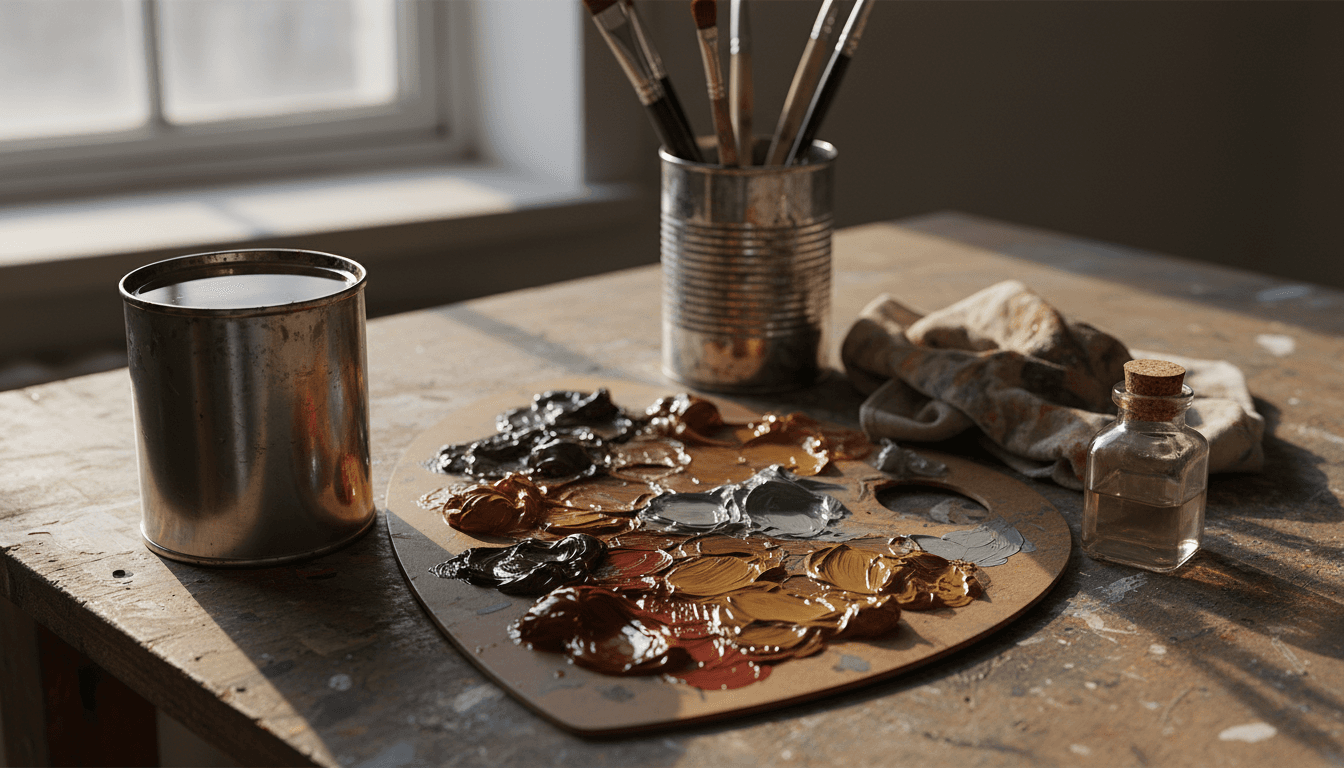
In Whaam!, three paints share one surface, and from a normal viewing distance they look the same. A white oil-modified alkyd primes the canvas; oil makes the blue and blue-red dots; a paint called Magna covers the red, the yellow, the black and some of the white. Tate's conservation team says the three look almost identical and can be told apart by their different levels of gloss. The difference matters when they clean, because mineral spirits, which may be appropriate for the oil, can easily damage the Magna paint.
That fragility is Magna's signature. It was the first paint made for artists from acrylic resin, and it dried fast to a hard film that dissolved again in the same turpentine or mineral spirits that had thinned it. A New York colourman launched it in 1947. Morris Louis poured it across raw canvas in a former dining room, Barnett Newman used it in his Stations of the Cross, and Roy Lichtenstein, when it was discontinued, snapped up what remained. Its life runs from a paint shop on 15th Street to a renovated barn in upstate New York, and it is not over: the people who look after Lichtenstein's paintings are still working out how to clean it. Tate says Lichtenstein added Magna to his palette in the early 1960s, so the 1960s paintings in the Whitney's Roy Lichtenstein: Like New, open until 10 May 2027, are a likely place to meet it this winter.
Origin: a very white paint
Leonard Bocour was born in New York on 18 March 1910 and by about 1933 had formed a company, Bocour Artists Colors, that sold artists' paint, according to Wikipedia. His nephew Sam Golden, born in 1915, started working with him in 1936, and the two began by hand-grinding oil colours for painters in Manhattan, Golden's entry says. The same entry says Willem de Kooning, Barnett Newman and Morris Louis were "regular visitors" at the shop on 15th Street, where they would "set up their drawing pads or easels and draw or paint in the tiny shop." Bocour's entry names Mark Rothko, Jackson Pollock, Helen Frankenthaler, Knox Martin and Kenneth Noland among the hundreds of painters who bought from him, and adds that he collected works by many of them. Golden Artist Colors' own history places Pollock and Rothko at the shop too, and says it "became a hangout for artists from the 1930s through the early 1950s."
Advertisement
The city those customers painted in had already been shown that paint could be anything. In 1936 the Mexican muralist David Alfaro Siqueiros set up an Experimental Workshop near Union Square, which the Whitney calls "a laboratory for modern aesthetic techniques." Its members, the museum says, "experimented with unorthodox materials and new ways of creating art," including "pouring and dripping paint onto canvas tacked to the floor," and the workshop "had a powerful effect on many artists, in particular Jackson Pollock." Eleven years later, Bocour's customers could buy a paint that could be thinned and poured.
The raw material had just changed jobs. Otto Röhm of the German firm Röhm & Haas had tried to make safety glass by polymerising methyl methacrylate between two layers of glass; the polymer separated from the glass as a clear plastic sheet, and in 1933 he gave it the trademark Plexiglas. In the Second World War, Wikipedia's entry on the material says, both Allied and Axis forces used acrylic glass for submarine periscopes and for aircraft windscreens, canopies and gun turrets; civilian uses followed after it. Magna's resin, n-butyl methacrylate, belongs to the same chemical family as the methyl methacrylate in Plexiglas.
The paint's own beginning is told as a story about white. Bocour found, Tate says, that the resin mixed with white pigment made "the whitest paint he had ever seen." He gave tubes to artists to test, the Morris Louis website says, and Louis was among the first. Golden's entry calls the result "the world's first artist acrylic paint"; CAMEO, the Museum of Fine Arts, Boston's conservation database, calls it "the first commercially available synthetic resin paints." Artsy calls it "the first-ever brand of acrylic paints formulated specifically for artists."
The year is less tidy than the legend. CAMEO gives 1947, citing Learner (2004), but notes that the Dictionary of Art dates the first use of acrylic to 1946 and that Lodge (1988) gives 1949 as the year it was sold. Wikipedia's history of acrylic paint says only that Bocour and Golden invented a solution acrylic between 1946 and 1949. Most sources settle on 1947, and so does this article.
Anatomy: what was in the tube
Magna at a glance
- Maker
- Bocour Artists Colors, New York
- Launched
- 1947 (sources say 1946–49)
- Binder
- n-butyl methacrylate resin
- Thinned with
- Turpentine, mineral spirits, xylenes, toluene
- Dry film
- Hard, matte, nonyellowing
- Redissolves in
- Xylenes, mineral spirits, turpentine
- Glass transition
- About 22 °C
- Discontinued
- Mid-1970s (CAMEO) or early 1990s (Tate)
- Descendant
- Golden MSA (Mineral Spirit Acrylic)
- Used by
- Louis, Newman, Lichtenstein
CAMEO describes the binder as n-butyl methacrylate resin, with the pigments dispersed in it, and the thinners as turpentine, mineral spirits, xylenes and toluene. That is what separates Magna from the acrylic in a modern tube. Liquitex and its descendants carry the resin in water; Magna dissolved it in solvent. The paint dried "rapidly to a hard, matte, nonyellowing film," in CAMEO's words, and the dry film dissolves in xylenes, mineral spirits and turpentine.
That last fact says how it dried. Linseed oil dries by reacting with oxygen, which is why a cured oil film resists the solvents that undo Magna. Magna simply lost its thinner and left the resin behind, which is why a swab of the right solvent can bring it back. CAMEO gives the resin a glass transition temperature of about 22 °C — the point at which a polymer passes from glassy to rubbery, and not far from the temperature of a mild room — and records that the formulation was changed in the 1950s to include small amounts of beeswax for added body.
The finish was adjustable. CAMEO calls the film matte; Wikipedia says Magna was glossier than most modern acrylics. The Morris Louis website explains how both can be true: thinned with turpentine, Magna dried matte; thinned with extra medium, it dried glossy and more slowly.
What acrylic offered over oil, Artsy's account says, was that it dried faster, did not yellow and could be applied as thickly as oil, "all while retaining full color saturation." The pitch was bolder than that. The Art Institute of Chicago says Magna was marketed as "the first new painting medium in 500 years". Five hundred years before 1947 is the age of Jan van Eyck, and the slogan invited a comparison with oil's arrival in the fifteenth century — the story behind Egg Tempera: The Medium Oil Replaced and Did Jan van Eyck Invent Oil Painting? — and with the binder Magna replaced in Louis's studio, linseed oil.
Use in Washington: raw canvas, turpentine and a dining room
In 1952 Helen Frankenthaler, after Clement Greenberg took her to Pollock's East Hampton studio, painted Mountains and Sea. Artsy's history of the technique describes the method as "applying oil paint that had been thinned down to the consistency of watercolor to unprimed canvas," which effectively stained the canvas with paint. Thinned oil had a flaw: it "loses some of its color saturation," Artsy says, and the results can "appear to be slightly washed out." On 3 April 1953, Wikipedia records, Louis and Kenneth Noland travelled to New York and met Greenberg, who arranged a visit to Frankenthaler's studio instead of introducing them to Pollock; Louis later called her "the bridge between Pollock and what was possible." Back in Washington the two began experimenting with the stain technique. They were among the earliest adopters of the new acrylic paint, Artsy says, and their canvases were "all the more saturated" than hers.
Advertisement
From 1954 Magna was the only medium Louis used, the Morris Louis website says, and the only acrylic he ever used. Wikipedia's entry on Louis dates his exclusive use of Magna to 1948; this article follows the Morris Louis website. He worked on unprimed cotton duck canvas, on which, in most of his paintings, Magna "penetrates the fabric and completely covers the fibers." With no ground between paint and cloth, the paint was the picture; Gesso, Grounds and Surface Preparation explains what a ground normally does. For the Veils of 1958–59 he thinned Magna with acrylic medium and then with large quantities of turpentine, poured it from the top edge or along the braces of the stretcher, and directed it to the bottom of the canvas. Artsy adds that the haloing effect around each stain results from the turpentine.
His studio, from 1952 until his death, was in his Washington home, in the room that had been the dining room, which the site's footnote measures at 14 feet by 12 feet 2 inches. The work stretcher for the 1958–59 Veils was about 8 by 12 feet, as large, the footnote says, as the room and the canvas dimensions allowed. The paint was the difficulty. Until April 1960 he obtained Magna in tubes, and its "thick, pastelike consistency" was, the site says, extremely difficult to grind down so that it dispersed in the thinner. He voiced numerous complaints to Bocour. In a letter of 1958 he asked for Magna "ground a bit more loosely" and wrote: "My hands get worn out from trying to ground the recent bees-wax stuff into a more liquid state." The beeswax was presumably the addition that CAMEO dates to the 1950s. His complaints continued until April 1960, when Bocour produced a special Magna formula for Louis and Noland, one with "a consistency like that of maple syrup," made by leaving out the suspending agent. The Unfurleds followed in 1960–61 and the Stripes in 1961–62.
Louis died on 7 September 1962, aged 49. He had been diagnosed with lung cancer that year, and Wikipedia says the illness was attributed to prolonged exposure to paint vapours. It does not say which paint or solvent. What the record does show is the room, the pour and the thinner.
Use in New York: Newman and Lichtenstein
Barnett Newman, one of the regulars at the Bocour shop, used Magna in the Stations of the Cross: fourteen canvases and a coda, Be II, made between 1958 and 1966 and shown at the Guggenheim from 20 April to 19 June 1966. Wikipedia's table of the series lists Magna on canvas for the First and Second Stations (both 1958) and the Tenth (1965), oil for the Third to the Eighth, plain "acrylic" for the Ninth and the Eleventh to the Thirteenth, and acrylic and Duco for the Fourteenth. Duco was DuPont's quick-drying nitrocellulose lacquer, developed in the 1920s and "made especially for the automotive industry"; Wikipedia adds that it was also used in paintings by Jackson Pollock. Yale's MAVCOR record gives each canvas as about 198 by 153 centimetres (roughly 78 by 60 inches) and places the set at the National Gallery of Art in Washington.
Newman bought other paint from Bocour too. In a 2019 chapter, Corina Rogge and Bradford Epley report that a Newman paint trial bears six paints whose elemental signatures, measured by X-ray fluorescence, closely match those of Bocour Artist Oil Colors paints, and that the swatches seem to relate to 14 works dating from 1954 to 1967. They call Bocour "the most innovative twentieth century U.S. artists' paint manufacturer", "best known for their introduction of Magna Plastic Artist Paint."
Lichtenstein came to Magna in the early 1960s, Tate says. The Art Institute of Chicago says it gave him the "smooth, matte, commercial, pop-art look he liked," which let him imitate mass-produced images such as advertisements and comic books, and quotes his loyalty: "I could paint with something else, but I'd have to learn to paint all over again." How he split the work, with oil for the dots and Magna for the flats, is the subject of Lichtenstein's Dots Weren't Printed; the comics behind those flats are the subject of Who Drew the Comics Lichtenstein Painted?.
Decline: the water took over
The competition came from water. The Mexican muralists Diego Rivera, David Alfaro Siqueiros and José Clemente Orozco were among the first to experiment with acrylic paint, Wikipedia's history says, impressed by its durability — the same Siqueiros whose New York workshop, the Whitney says, had a powerful effect on Pollock. Politec colours began to be produced in Mexico in 1953. In 1956, the same history says, José L. Gutiérrez produced Politec Acrylic Artists' Colors there and Henry Levison of the Cincinnati firm Permanent Pigments Co. produced Liquitex, and it calls those two lines the first acrylic emulsion artists' paints. CAMEO's entry on polymer colours dates the first marketing of Liquitex to 1954, with Rhoplex AC-34 as its base polymer. Whichever date is right, water-based acrylic was on sale within six to nine years of Magna's launch.
Advertisement
Bocour moved too, though later. CAMEO's polymer-colours entry says that by 1963 several brands of acrylic emulsion were on the market, among them Shiva, Liquitex, Hyplar and Aqua-tec, and lists Aqua-tec as a Bocour Artists' Colors brand. Frankenthaler, who had begun with thinned oil, "switched over to acrylic paints" in 1962, Artsy says, and Artsy calls Magna "ultimately short-lived." On CAMEO's date it lasted nearly three decades; on Tate's, more than four.
When Magna itself ended is disputed. CAMEO says Bocour discontinued it in the mid-1970s, citing Crook and Learner (2000); Tate's page puts the end of its production in the early 1990s. Both cannot be right, and the sources checked here do not settle it. One more data point comes from Wikipedia's entry on Bocour, which says the company "sold artist paints from the late 1930s until the 1990s." That says nothing about Magna in particular, but it shows the firm outliving the earlier date by years. Tate and the Art Institute at least agree on what Lichtenstein did about the loss. The Art Institute says that when Magna was discontinued he snapped up all the available stock and contacted Golden Artist Colors to get a paint of similar formula. If the earlier date is right, that stock had to carry him a long way, because Golden Artist Colors did not exist until June 1980.
Afterlife: a barn in New Berlin
Wikipedia's entry on Bocour dates his partnership with Golden in the firm to 1952–1970. In June 1980 Sam Golden came out of retirement and, with his wife Adele, his son Mark, his daughter-in-law Barbara and a partner, Chuck Kelly, founded Golden Artist Colors in a 900-square-foot renovated barn in New Berlin, New York, the company's history says. Despite worldwide distribution, it adds, the product is "still created on the grounds of the original barn."
What Golden made for Lichtenstein, and for everyone since, is MSA — Mineral Spirit Acrylic. Golden describes its MSA Conservation Paints as paints "made from Mineral Spirit-based Acrylic (MSA) resins" that dry quickly, and calls them "exceptionally useful in art conservation" because "they remain soluble in mineral spirits" — "ideal for easy removal," it says, "without disturbing the layers of paint underneath." CAMEO describes MSA as a similar formulation to Magna. Wikipedia's entry on Magna says any differences between the two are small, if any, and that Lichtenstein thought the colour range of MSA better than Bocour's. Tate says he worked with Golden Artist Colors to produce a similarly formulated paint, MSA, so that he could "continue to work in his well-honed aesthetic until his death in 1997." Golden himself had died on 11 March that year.
The irony is the point. The property that makes Magna hard to clean — it dissolves — is the property that makes its descendant useful to conservators, since a retouch in it can be taken off again. Golden's instructions still carry the old paint's condition: thin with full-strength commercial mineral spirits (white spirits with more than 6 per cent aromatic content); do not use "odorless" or "low odor" solvents unless they have been tested first for compatibility; and be wary of turpentine, a "more aggressive, 'hotter' solvent" that, Golden says, "presents additional health concerns and a greater chance of reactivating previously applied layers of MSA-based products." For those reasons Golden tends not to make it one of its top recommendations for thinning.
The conservators' problem is that Whaam! holds three paints with three sensitivities: each paint type, Tate says, "varies in its response to the kind of cleaning options we have." The painting's white highlights are "looking grey," and there are greasy finger marks around its edges, "a vestige from the decades past, deposited before we realised that gloves must be worn." Its "jet-set life style," the page adds, has left it with a "slightly soiled appearance." Because the team cannot use Lichtenstein's painting to test new cleaning materials, Tate's NANORESTART project made test paintings instead: cotton canvases, three painted in stripes of Magna-like acrylic — Golden MSA paint, "kindly donated" — and one with oil-painted Ben-Day dots and no Magna layer. After three days of air-drying they were moved to an artificial ageing chamber, with "artificial finger grease and indoor soil" to be applied midway through the ageing.
Where it is now
Whaam! has been in Tate's collection since 1966. The National Gallery of Art in Washington holds Newman's Stations. At its Lichtenstein exhibition the Art Institute of Chicago explained that its labels do not say "oil and acrylic" but, more specifically, "oil and Magna on canvas." Its conservation scientist, Francesca Casadio, had worked out which was which with a miniaturised infrared instrument, in the early mornings before the galleries opened, and found oil in the dots and Magna in the solid areas of colour. The Whitney's labels for Roy Lichtenstein: Like New will show whether it uses the same wording; How to Experience Art Exhibitions Meaningfully has advice on looking slowly.
Advertisement
Magna itself is a discontinued formula, and what survives of it hangs on walls: Newman's tall canvases in Washington, Louis's poured Veils in museum collections, Lichtenstein's flats at Tate and, very probably, among the 1960s paintings at the Whitney until 10 May 2027. All of them are in a paint that, in principle, a swab of the right solvent could still undo.
For the water-based paint that outlived it, and the way it shifts as it dries, see Why Acrylic Paint Dries Darker.