Vermilion and the Mercury That Made It
Vermilion was the reddest red the old world could make, and it came from mercury. Here is how a toxic mineral became the colour of Roman walls and Renaissance robes.
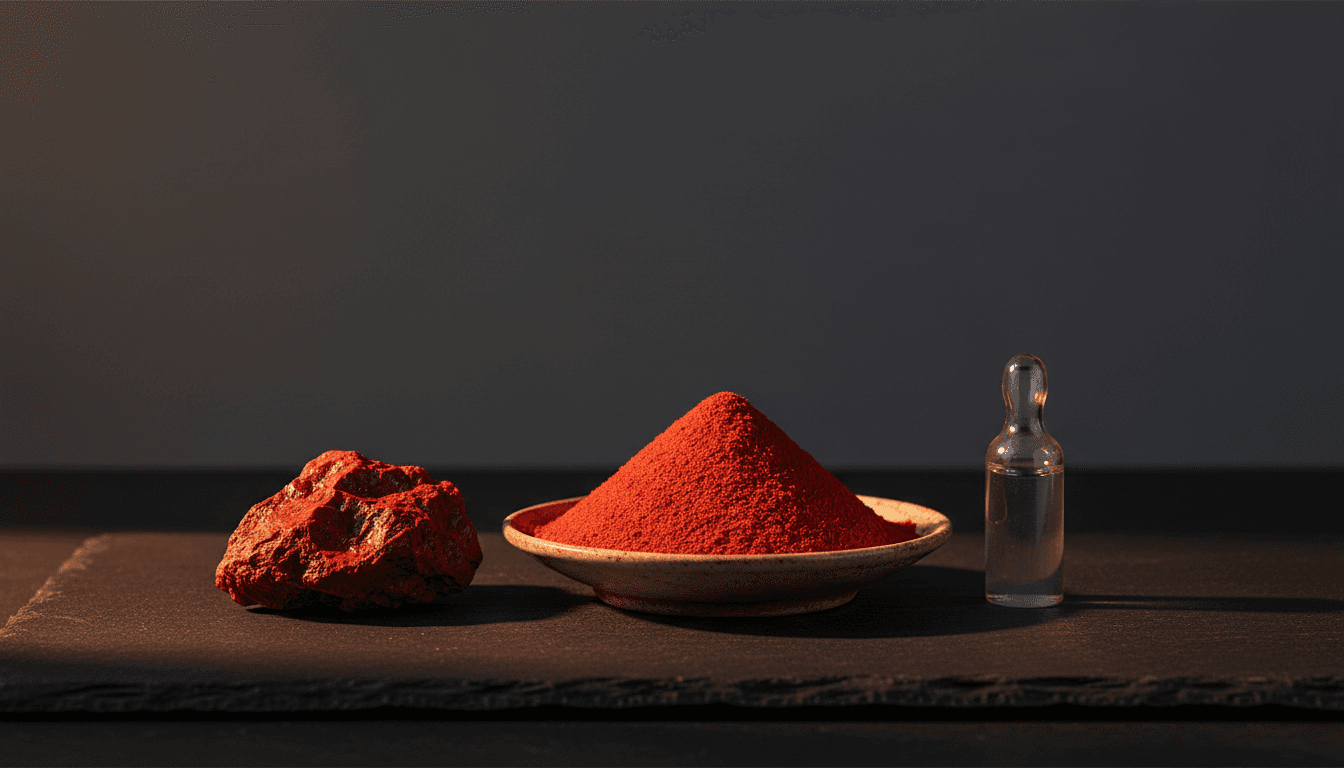
Cut open a piece of raw cinnabar and it bleeds red — a heavy, saturated scarlet unlike almost anything else the earth produces in mineral form, dense enough to feel wrong in the hand for its size. That weight is mercury. The mineral is mercury sulfide, and for most of the history of the pigment ground from it, the two facts — the most brilliant red available and one of the most poisonous substances known — were never separable.
Origin: born in fire underground
Cinnabar forms in volcanic and hydrothermal settings, where mercury-rich fluids cool and deposit the mineral in veins. The largest and most consequential deposits on earth sat at Almadén in central Spain and Idrija in what is now Slovenia, and both became bywords for the human cost of extracting them. The Roman world mined Almadén intensively, using convicts and slaves in a mine so associated with death that being sentenced to it was effectively a death sentence — mercury vapour accumulates in the body, and continuous exposure produced tremors, confusion, and organ failure in the people who worked there.
Becoming a pigment: two routes to the same red
The mineral could simply be ground, but the ground stone was variable in quality and expensive to transport from a handful of mines. So makers in China and the Middle East, long before the technique reached Europe, learned to synthesise the identical compound by combining mercury with sulfur and heating them — a process that produced a more consistent pigment that could be made anywhere, called vermilion. The synthesis was dangerous in its own right: the reaction released mercury vapour, and the workshops that made vermilion were as hazardous as the mines that supplied the raw metal. By the medieval period, synthetic vermilion had become a standard pigment in European workshops, prized because nothing else matched its brightness — a mineral answer to red that owed nothing to the organic reds, like cochineal, being extracted from insects during the same centuries.
Life in use: the colour of importance
Vermilion became the pigment of things that needed to command attention. Roman wall painters used it for whole rooms. Chinese artisans used it for lacquerware and for the official seals still stamped in red today. European manuscript illuminators and, later, Renaissance painters used it for drapery, for lips, and for the accents meant to read from across a room — often laid in as a flat, opaque layer and then glazed with translucent red lakes, which modelled the folds and deepened the shadows that so dense and covering a pigment could not supply on its own.
Advertisement
Middle age: the fault that comes with time
Vermilion carries a well-documented weakness: it can darken, sometimes turning black, over years or decades. The main agents are light and chlorides working together. For decades the black was put down to metacinnabar, a black form of mercury sulfide — chemically the same compound, structurally rearranged — but that was never convincingly proved, and analyses of darkened paint since the early 2000s have mostly found mercury-chlorine compounds such as calomel and corderoite instead; exactly which product turns the surface black is still being argued over. A second cause is contact with lead-based pigments nearby, which can produce dark compounds at the interface between the two. The change is slow, environment-dependent, and irreversible once advanced, which is why conservators studying old paintings have to account for vermilion passages that may no longer show the colour the artist actually mixed.
Retirement: replaced, not because it failed to be red
Vermilion's twentieth-century retirement came from cadmium reds, which are brighter, more chemically stable, and dramatically less toxic to produce. The replacement wasn't really about colour — vermilion's red was never in question — it was about the two problems that had shadowed the pigment for its entire life: a tendency to blacken with age, and a manufacturing process that had poisoned people for as long as anyone had made it, in the same way emerald green and mummy brown eventually fell out of use for reasons that had nothing to do with how they looked on canvas. Cadmium solved the first problem outright and the second one enough to matter, and painters largely stopped reaching for a pigment that had defined red for centuries.
Where it stands now
Vermilion still exists — in historic paintings that conservators study for exactly the blackening it's prone to, in a small trickle of specialist and traditional production, and in the geological record of mines like Almadén, which mercury's global regulation has mostly closed. What it no longer is, is an active working pigment. Its afterlife is entirely as an object of study: a colour that shows, more clearly than almost any other in the historical palette, how a material's beauty and its cost were never actually two different stories.