10 of the Most Expensive Pigments You Can Still Buy, Priced by the Gram
Genuine Tyrian purple still sells for more than €2,500 a gram before tax. Ten of the most expensive pigments you can still order, what each costs per gram, and the cheaper ways to paint with them.
You've stood in front of a Fra Angelico altarpiece, looked at the Virgin's robe and wondered whether you could paint with the same blue. You can. It ships in a 5-gram glass jar, and it costs €117.05 before tax.
Most of art history's legendary pigments are still for sale — a handful of specialist colourmen still grind, wash and jar them. What has changed is the distance between them. Genuine Tyrian purple costs more per gram than almost anything else an artist can order, while azurite, the blue medieval painters used because ultramarine was beyond them, now costs about €1.38 a gram. How those prices were set in the first place is the subject of the most expensive colours in history. This guide is about what they cost now, and how to buy them without wasting money.
Every price below was checked in November 2026 on the supplier's own listing. Kremer Pigmente's figures are net of VAT unless marked; US prices are retail. Expect them to move — the gold one moves with the metal.
The ten, from most to least expensive per gram
1. Tyrian purple, genuine — about €2,560 a gram
Kremer Pigmente lists one gram of genuine Tyrian purple (#36010) at €2,562.55 before VAT, or €3,049.43 with German VAT. A 25-milligram vial costs €75 — which works out at €3,000 a gram, so the small vial is the dearer way to buy. Kremer's own description puts the yield at about 10,000 sea snails per gram. The molecule is 6,6′-dibromoindigo, the colour that once edged the togas of Rome's senior magistrates; how it got that status is in why purple was so expensive.
The cheaper way in: the "Tyrian Purple" in Winsor & Newton's Revival watercolours is a modern alternative to the snail dye, not the snail dye itself, and a 5 ml tube is $8.90 at Art Supply Warehouse.
2. Purpurissum — about $150 a gram
Purpurissum is the stretched version: Kremer makes it (#36015) from Tyrian purple and stone powder, reviving a name from Roman painting. Beeck Mineral Paints in the US sells a single gram for $149.99 — more than four times what the same shop charges per gram for the best lapis on this list.
3. Shell gold — about €90 a gram
Shell gold is powdered gold bound in gum arabic and pressed into a small cake you wet with a brush, like watercolour. The name comes from the shells — mussel shells among them — it was once mixed and stored in. Natural Pigments sells 23.75-carat shell gold in 0.3, 1 and 2 gram sizes; Berlin's Modulor lists a Rosenoble tablet of about 1.1 grams at €99.90 including VAT, roughly €91 a gram. Its price follows the gold market, so this is the one entry that can change by the week. What gold does on a painted surface is covered in why gold never reads as just yellow.
Advertisement
4. Lapis lazuli, purest ("Fra Angelico Blue") — about €23 a gram
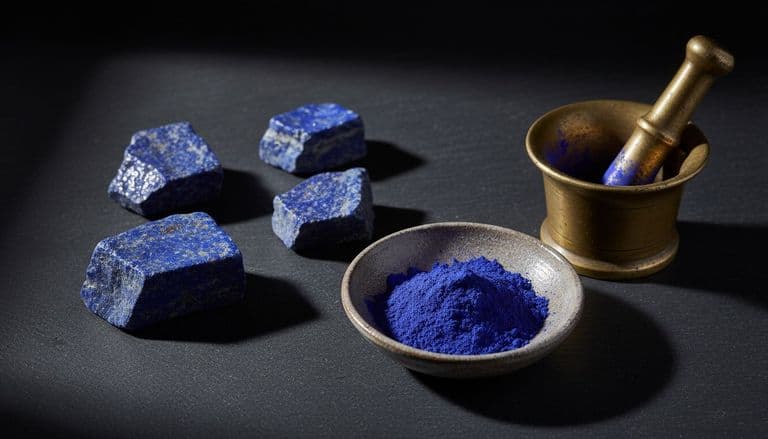
Kremer sells genuine ultramarine in four grades. The top one, #10530, is sold as Fra Angelico Blue and made by the method Cennino Cennini described around 1400: the ground stone is kneaded into a dough of wax and resin, and the blue is washed out of it in water. By Kremer's count, 100 grams of stone yield 4 grams of pure pigment. The 5-gram jar is €117.05 net — €23.41 a gram — and in the US, Beeck sells 10 grams for $349.99.
Below it, prices fall fast: €80.05 for 10 grams of Kremer's "good quality" grade and €35.60 for 10 grams of its "medium quality". Natural Pigments sells Afghan lapis at $30.80 for 10 grams. If you want it ready-made, Michael Harding's Lapis Lazuli (No. 702) is a Series 7 oil, $140.87 at regular price for a 40 ml tube at Wet Paint. For what a Florentine painter paid for the same blue, see how much ultramarine cost.
5. Maw Sit Sit — about $22 a gram
A green rock of kosmochlore and jadeite from Myanmar, ground by Kremer (#10290) and sold by Beeck at $111.99 for 5 grams. It has no old-master pedigree. It is on this list because the stone is a scarce gem, which is a different reason for a high price than labour or chemistry — and a reminder that price per gram measures rarity, not usefulness.
6. YInMn Blue — about €4.40 a gram
The newest pigment here. Mas Subramanian's team at Oregon State University found it by accident in 2009 while working on materials for electronics. It is a mixed oxide of yttrium, indium and manganese, and Kremer, which describes indium as extremely rare, says it is still produced only in small quantities. Kremer sells 10 grams for €44 net; New York Pigment Co. lists 10 grams at $92. When YInMn paint first reached American artists in 2021, a 1.35-ounce bottle sold for $179.40. Golden's own verdict on the hue is cooler than the hype: it lands between cobalt blue deep and ultramarine.
7. Natural cinnabar — about $4.50 a gram
Mined mercury sulfide. Kremer's comes from Monte Amiata in Tuscany (#10610), and Beeck sells 10 grams for $44.99. Natural Pigments treats cinnabar as toxic and urges caution with the dry powder — take that seriously. Vermilion, further down, is the manufactured version of the same compound; its history is in vermilion and the mercury that made it.
8. Azurite — about €1.38 a gram
Kremer calls azurite the oldest blue pigment, used almost worldwide long before lapis lazuli. Its natural, standard grade (#10200) is €13.75 for 10 grams. Medieval painters often laid azurite down first and finished with ultramarine on top — the cheaper blue doing the bulk of the work. One catch: azurite is a copper carbonate, and copper shifts colour in acidic binders such as linseed oil. Kremer's "MP" azurites, developed by a customer of the firm, Michael Price, are coated in protein so they keep their blue in oil.
9. Carmine — about €0.84 a gram
Carmine Naccarat (#42100) is an aluminium lake of carminic acid, the red of cochineal insects: €21 for 25 grams, €77.80 for 100. Kremer's listing flags it as not lightfast, which is the old problem with the insect reds. Use it for studies, not for anything you want to keep its colour.
10. Vermilion — about £0.68 a gram
Genuine vermilion, manufactured mercury sulfide, is £17 for 25 grams at Cornelissen in London. It won't ship outside the UK, and its safety sheet tells you to dispose of it as hazardous waste. The red that Renaissance painters prized above almost any other now costs less than a pound a gram — and is harder to post than to pay for.
Price per gram at a glance
| Pigment | Listing | Price | Per gram |
|---|---|---|---|
| Tyrian purple, genuine | Kremer #36010, 1 g | €2,562.55 net | about €2,563 |
| Purpurissum | Beeck Mineral Paints, 1 g | $149.99 | about $150 |
| Shell gold, 23.75 carat | Modulor, about 1.1 g | €99.90 incl. VAT | about €91 |
| Lapis lazuli, purest (Fra Angelico Blue) | Kremer #10530, 5 g | €117.05 net | about €23 |
| Maw Sit Sit | Beeck Mineral Paints, 5 g | $111.99 | about $22 |
| YInMn Blue | Kremer #45320, 10 g | €44.00 net | about €4.40 |
| Natural cinnabar, Monte Amiata | Beeck Mineral Paints, 10 g | $44.99 | about $4.50 |
| Azurite, natural | Kremer #10200, 10 g | €13.75 net | about €1.38 |
| Carmine Naccarat | Kremer #42100, 25 g | €21.00 net | about €0.84 |
| Vermilion, genuine | Cornelissen, 25 g | £17.00 | about £0.68 |
Two things stand out. The list is a cliff, not a slope: Tyrian purple costs about a hundred times the best lapis, and the best lapis costs about seventeen times azurite. And the pigments that defined their centuries — azurite, carmine, vermilion — sit at the bottom, undercut by industrial chemistry long ago. What artists actually paid for pigments shows how that happened.
Before you order
- Check whether tax is included. Kremer's European shop shows prices with 19% German VAT and the net price beside them; its US shop shows net prices. A comparison across shops that ignores this is off by almost a fifth.
- Buy the size you will use. Small jars cost more per gram — compare the €3,000-a-gram Tyrian purple vial with the €2,562.55 gram — but a 100-gram jar of Fra Angelico Blue is €1,981.25 you may never use.
- Match the pigment to the binder. Lapis has a refractive index close to linseed oil's (Kremer gives 1.50–1.54), so in oil it turns glassy and transparent; it keeps more body in egg tempera and watercolour. Uncoated azurite belongs in water-based binders, acrylic or tempera.
- Handle the mercury reds properly. Weigh and mull cinnabar and vermilion with a mask on, never sand a dry layer, and keep the powder away from food and children.
- Ask what you're paying for. Genuine ultramarine particles are irregular and glassy; synthetic French ultramarine is fine and uniform, and the two paint differently. Tyrian purple's case is history rather than hue — a modern violet gets you the colour for the price of a coffee.
Advertisement
What money can't buy
Some colours are off the market at any price. Vantablack's makers granted Anish Kapoor exclusive rights to its artistic use in 2016. Indian yellow hasn't been made for about a century, and mummy brown disappeared when its makers ran out of mummies. Everything on the list above, by contrast, is a checkout page away.
FAQ
What is the most expensive pigment you can buy?
Among pigments sold to artists, genuine Tyrian purple. Kremer Pigmente lists one gram (#36010) at €2,562.55 before VAT, or €3,049.43 with German VAT, and puts the yield at about 10,000 sea snails per gram. Its 25-milligram vial is €75, which is even more per gram.
Is genuine ultramarine better than synthetic ultramarine?
It's different rather than simply better. Genuine ultramarine from lapis lazuli has irregular, glassy particles and paints transparent, with low tinting strength; synthetic French ultramarine is fine and uniform and much stronger. Painters choose the genuine pigment for its depth in glazes and in egg tempera, not for coverage. See how much ultramarine cost for why it was once worth more than gold.
Can I buy genuine lapis lazuli as ready-made paint?
Yes. Michael Harding makes a Lapis Lazuli oil (No. 702, Series 7), sold at $140.87 regular price for a 40 ml tube at Wet Paint, and small watercolour makers such as Agallo Colors make pans with Fra Angelico-grade lapis. As dry pigment, Kremer sells four grades and Natural Pigments sells Afghan lapis at $30.80 for 10 grams.
Why is "Tyrian purple" watercolour so cheap?
Because it isn't the snail dye. Winsor & Newton presents the Tyrian Purple in its Revival range as an alternative to the murex version, and Agallo's Tyrian purple is made from ultramarine violet and manganese violet (PV15 and PV16). They match the colour, not the chemistry — which is why a tube costs a few dollars rather than a few thousand euros a gram.
Is cinnabar safe to paint with?
Treat it as toxic. Cinnabar and vermilion are both mercury sulfide; Natural Pigments urges caution with the dry powder and with the pigment in a binder, and Cornelissen's safety sheet for genuine vermilion says to dispose of it as hazardous waste. Wear a mask when weighing or mulling, avoid making dust, and never sand a dried layer.