Did Jan van Eyck Invent Oil Painting?
Vasari credited Jan van Eyck with inventing oil painting. Evidence from about 1125 says otherwise. What the National Gallery's portraits show instead.
Did Jan van Eyck invent oil painting? Plenty of people will still tell you he did, and the claim comes from Giorgio Vasari, writing in the sixteenth century. On 21 November 2026 the National Gallery opens Van Eyck: The Portraits — the first time, the Gallery says, that all nine of his known painted portraits have been seen together — and the paintings in that room are the reason the claim has lasted. They are also the reason it's wrong in a more interesting way than the slogan suggests.
The evidence is older than Vasari, and it points the other way.
The show: nine portraits, one drawing and the backs of the panels
- Exhibition
- Van Eyck: The Portraits
- Venue
- National Gallery, Ground Floor Galleries
- Dates
- 21 November 2026 – 11 April 2027
- Portraits
- All nine known painted portraits
- Also shown
- His only surviving drawing
- Curator
- Emma Capron
- Tickets
- £18 standard; under-18s and members free
Van Eyck: The Portraits runs from 21 November 2026 to 11 April 2027 in the Gallery's Ground Floor Galleries; standard tickets are £18, including an audio guide, and under-18s and members go free. The nine painted portraits make up about half of the twenty or so surviving autograph pictures, according to the Gallery's press release, and they come from across Europe. The Arnolfini Portrait (1434), the Gallery's own, will be shown with Berlin's Portrait of a Man (Giovanni? Arnolfini) for the first time; the Berlin panel shows the same sitter. The Gallery's Portrait of a Man (Self Portrait?) (1433), newly conserved, will hang beside Bruges's Margaret, the Artist's Wife (1439), which a second release calls "the first dated identifiable portrait of a woman who was not a member of the aristocracy." Vienna's Kunsthistorisches Museum is lending both of its van Eycks at once, which the Gallery says has never happened before; one of them is Jan de Leeuw (1436).
The Gallery says the show foregrounds "new research on the artist's technique, original frames and cryptic inscriptions" and addresses "lingering controversies over his sitters' identities"; its catalogue, edited by the curator Emma Capron and Nicholas Flory, is billed as the first monograph on his portraits. The frames are part of the argument. "Painted on every side, van Eyck's portraits are three-dimensional objects," the second release says, and several will be shown "in the round" for the first time, revealing the marbling that survives on their backs. The same release notes that van Eyck "almost systematically signed his paintings" and that the meaning of his inscriptions "often remains obscure." One drawing joins the nine paintings: van Eyck's only surviving sheet, on loan from Dresden, which the Gallery calls "the only certain preparatory study for any Netherlandish painting of the period" and "the earliest material record of a formal sitting to survive."
Advertisement
Capron frames the portraits as a beginning without a prehistory:
Some stories do not have a beginning. Portraiture is one of them. It bursts onto the scene fully formed in the 1430s under the brush of Jan van Eyck.
That is a different claim from Vasari's — it concerns the portrait, not the paint — but it has the same shape: one painter, one decade, no ancestors. The material released so far doesn't spell out what the technical research found about his paint, so that will have to come from the room itself. Both claims can be tested against the record, and the older one comes first.
The claim: a panel that split in the sun
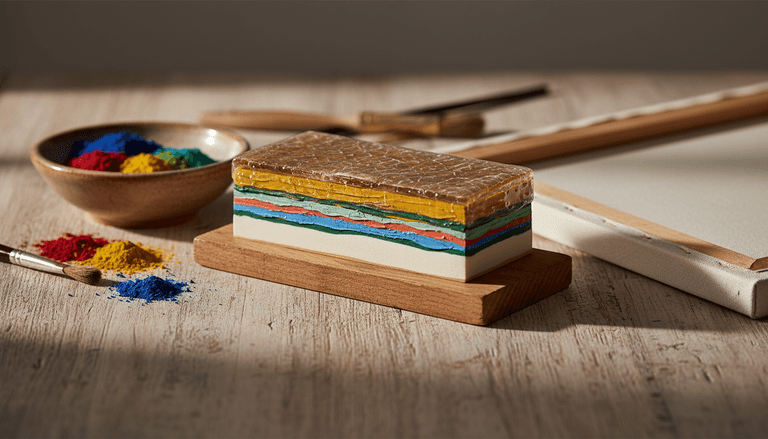
Vasari tells it in his life of Antonello da Messina, the painter he credits with bringing the method to Italy, and it begins with a ruined picture. John of Bruges — Jan van Eyck — was looking for a better medium than tempera. He varnished a finished panel and set it in the sun to dry, and the panel opened at every joint: the heat was too great, Vasari writes, or the wood not seasoned enough. Determined to find a varnish that would dry in the shade, he tried different oils, and in Gaston du C. de Vere's 1912 translation he found that
...the oil of linseed and the oil of nuts were the best for drying of all that he tried.
Boiled with his other mixtures, they gave him the varnish he wanted. Vasari adds that colours mixed with these oils had more lustre without any varnish, were safe from water once dry and, in his words, "blended better than in tempera." The story ends with the claim that made van Eyck's name in Italy:
The fame of this invention soon spread not only through Flanders, but to Italy and many other parts of the world.
Two details matter. What Vasari describes is a drying oil — a better varnish and a medium that blends — rather than oil painting appearing from nowhere. And he tells it from Italy, more than a century after van Eyck's death in 1441, in a life whose job is to explain how Italian painters came to have the technique. A story with that job to do reads better as a founding myth than as workshop history. The split panel at least rings true: wood panels were hostile to heat and humidity, a problem that eventually pushed painters towards canvas.
The man behind the claim: a court painter who settled in Bruges
The man Vasari calls John of Bruges was a court servant before he was a Bruges burgher. The first record of him is a run of payments at The Hague between 1422 and 1424 to "Meyster Jan den malre" — Master Jan the painter — who held the rank of valet de chambre to John of Bavaria, ruler of Holland. After John's death in 1425 he entered the service of Philip the Good, Duke of Burgundy, working at Lille, and in 1428 he joined the embassy sent to Lisbon to negotiate Philip's marriage to Isabella of Portugal. The second release says he painted her portrait so it could be sent back to Flanders for the duke's approval; it is now lost. Philip and Isabella married on Christmas Day 1429, and van Eyck moved to Bruges the same year.
He bought a house there around 1432 and married Margaret, who was about fifteen years younger and whose maiden name is unknown. The couple's first child was born in 1434, and the duke stood as godfather. Van Eyck died in Bruges on 9 July 1441 and was buried at St Donatian's; Philip paid his widow a one-off sum equal to the artist's annual salary.
The record has a gap exactly where the invention story needs it. The paintings confidently attributed to him — about twenty — are all dated between 1432 and 1439. The Ghent Altarpiece, completed in 1432 for St Bavo's, is credited to him and his brother Hubert, who died in 1426; art historians believe Hubert began it around 1420 and Jan finished it. For the decade before, the surviving record is largely payments rather than paintings. By 1432 van Eyck had been a documented court painter for at least ten years, so the evidence for what he could do in oil starts with a man long past apprenticeship.
The evidence against: oil was already in use
The earliest evidence pushes the date back by centuries. A craft treatise attributed to Theophilus, dated to about 1125, already tells painters how to work with linseed oil — more than three centuries before van Eyck painted the Arnolfini Portrait in 1434. Painted objects point the same way: the Hemse crucifix from Gotland, Sweden (about 1180) shows evidence of drying oils, and a Norwegian altar front from Tingelstad (1300–25) is cited among the early examples. A 2008 study went further, reporting drying oils — probably walnut and poppy-seed — in cave paintings at Bamiyan in Afghanistan dated to around AD 650, though how far such techniques spread from there isn't known. The Eclectic Light Company's survey of the evidence sets it all out.
Advertisement
Researchers who have looked at van Eyck's materials land in a similar place. Noëlle Streeton's 2013 study, as summarised in that survey, found that the van Eycks' materials were similar to those of other early Netherlandish painters and the generation before them. What set the workshop apart was practice: their paintings usually, though not always, involved multilayered paint, including glazes. Linseed and walnut oil remain two of the most familiar drying oils, and Linseed vs. Walnut Oil: What Changes in Paint covers how they differ.
What the paintings show: time to blend
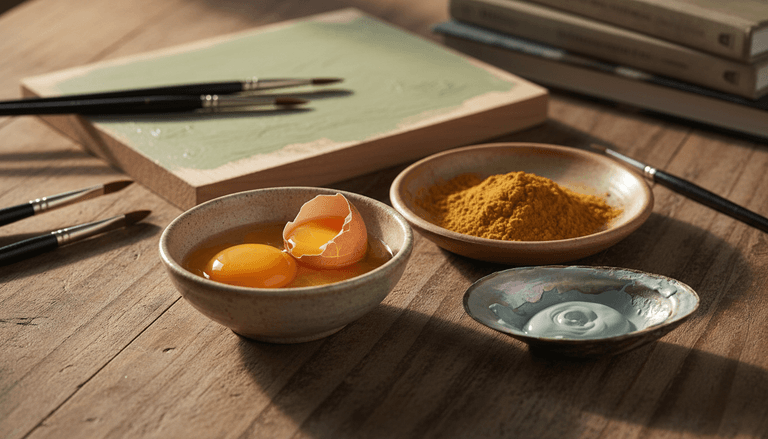
If the medium isn't his invention, the evidence for what he did with it is on the panel. The Arnolfini Portrait is oil on three vertical oak boards, 82.2 by 60 centimetres, built up in several thin, translucent glazes. Oil's longer drying time, compared with tempera, let him blend colours wet-in-wet — the thing egg tempera couldn't offer, since it sets almost as soon as it touches the panel. The slowness is chemistry: oil paint dries by oxidation, not evaporation, which is what gives a painter days rather than minutes.
Infrared reflectography shows how he spent that time. According to the Gallery's catalogue entry, the underdrawing was made in stages: the first sketched the figures, the main furniture and the basic architecture, and left out the dog, the chandelier, the chair, the beads and the shoes, which came later. In that first drawing the man had a larger face, different feet, a shorter robe and a larger hat, and the woman looked up towards him; a second drawing improved his proportions and idealised his features. The paint went on quickly and freely — he used his fingers and brush handles as well as brush tips, and a thumbprint is visible near the shadow of the dog's leg. The entry calls the pigments unremarkable and says the illusion relied on skill rather than technical innovation, which is Streeton's finding seen on a single panel.
It has been suggested that he used a magnifying glass for the highlights on the beads beside the mirror. David Hockney's wider theory that van Eyck traced projected images with lenses is disputed by many art historians; Did Vermeer Secretly Use a Camera? covers the Hockney–Falco thesis in Vermeer's case. The same panel carries the inscription Johannes de eyck fuit hic 1434 — "Jan van Eyck was here" — which the history of the artist's signature reads as a witness's oath rather than branding.
A face in dabs: the self-portrait the Gallery has just conserved
The Gallery's own Portrait of a Man (Self Portrait?) shows what that slowness bought at small scale. It is oil on wood, probably oak, 26 by 19 centimetres, dated 1433, and the Gallery bought it in 1851. The sitter's stubble is built from tiny individual dabs of paint — darker brown dots first, then mostly white lighter ones, with a little blue mixed into the white on the chin. There is relatively little underdrawing, which suggests van Eyck adapted the picture as he painted; he enlarged the nose and turned it further into profile than the rest of the face to make the likeness more recognisable. The Gallery's entry says the black background is almost certainly overpaint over an original blue, and describes the sitter's houpelande as purplish-brown, with vertical pleats across the chest. The press release doesn't say what the new conservation did about the background.
The frame is original, and it is part of the picture. Along the top, in large Greek letters, runs the motto Als Ich Can — "as I can", the Gallery glosses it, with Ich standing in for Eyck. Along the bottom is the signature, in abbreviated Latin: Jan van Eyck made me on 21 October 1433. Both inscriptions are painted to look carved. The ruled guidelines for the signature were drawn wrongly and redone, and the letters of October are squeezed in without a full stop. The back of the panel is covered in a thin layer of black paint that isn't original, but a small area of chalk ground near the lower edge shows the reverse was meant to be painted.
The Gallery calls the sitter "almost certainly" van Eyck himself, citing the way he leans forward as if looking in a mirror and the slightly different directions of his eyes; no other portrait of him survives to check it against. The panel's own history shows how fragile that identification is. An inscription on the back ties it to the collection of Thomas Howard, Earl of Arundel, who had it in Antwerp in 1642–44, where a Flemish visitor recorded it as a portrait of the "Duke of Barlaumont." The 1655 Amsterdam inventory of Arundel's widow, Alathea Talbot, apparently lists it instead as a portrait of Jan van Eyck by his own hand. If that entry means this panel, the self-portrait reading is more than 370 years old.
Advertisement
Who he painted: the Arnolfini puzzle
The Arnolfini Portrait is the room's best-known picture and its biggest open question. The Gallery's entry calls it Portrait of Giovanni(?) Arnolfini and his Wife and says the couple are probably Giovanni di Nicolao di Arnolfini, an Italian merchant working in Bruges, and his second wife, whose identity is unknown. It no longer reads the picture as a marriage ceremony — the interpretation Erwin Panofsky set out in a 1934 article in the Burlington Magazine, which treated the inscription and the two figures in the mirror as witnesses to a legal record. No other reading has won consensus. Crowe and Cavalcaselle linked the picture to Margaret of Austria's inventories in 1857, and in 1861 Weale named the wife as Giovanna Cenami; for about a century most historians accepted Giovanni di Arrigo Arnolfini and Cenami as the couple, until a chance discovery published in 1997 showed that the two married in 1447 — thirteen years after the date on the panel and six years after van Eyck's death. Margaret Koster argued in Apollo in 2003 that the woman had already died, which would make the picture a memorial portrait. The early records don't settle it: they name the man "Hernoul le Fin" or "Arnoult Fin."
Its route to Trafalgar Square is better documented than its sitters. Don Diego de Guevara, a Spanish nobleman who died in Brussels in 1520, is the first recorded owner; he gave it to Margaret of Austria, whose inventory at Mechlin lists it on 17 July 1516. It passed to Mary of Hungary and then to Philip II of Spain, and the Madrid palace valued it at 6,000 reals in 1794. After it left Spain, probably during the Peninsular War, it turned up with a Scottish soldier, James Hay; the Gallery's entry says only that it is possible he took it from Joseph Bonaparte's baggage at Vitoria in 1813. The Trustees recommended buying it on 2 May 1842 for "the moderate price" of 600 guineas, and the entry calls it "our first Netherlandish painting."
Did portraiture have ancestors?
Capron's claim is easier to test than Vasari's, because earlier likenesses survive. The Louvre holds one of the best known: a panel of John II the Good of France, which the museum dates to about 1355–60 — tempera on a gold ground, on canvas glued to oak, roughly 60 by 45 centimetres, with the king in profile. A catalogue entry describes it as among the earliest ruler images painted on a wooden panel, but its authors caution that, with so few contemporary likenesses to compare it with, there is no way to know whether it was a portrait in the modern sense. The Louvre's own record adds that the inscription naming the king was probably added later.
Capron's own sentence concedes the point and redefines it: "None of the stylised likenesses that preceded his work would pass as a portrait today: you would not recognise their sitters if you walked by them on the street. This changes with van Eyck." That is a claim about recognisability, not priority, and it is more defensible than "fully formed." The Gallery's wider case is about who gets portrayed. Van Eyck's sitters included affluent merchants, successful craftsmen and the artist's relatives, not only royalty and aristocrats, and the qualifiers in the Gallery's line about Margaret — the first dated identifiable portrait of a non-aristocratic woman — do real work.
After van Eyck: how oil reached Venice
Vasari's story doesn't stop in Bruges; it needs the secret to reach Italy, and it routes it through one man. In his telling, a picture by John of Bruges at the court of King Alfonso of Naples sends Antonello da Messina to Flanders, where the ageing painter lets him see his method; after John's death Antonello carries it home to Messina and on to Venice, where he teaches it to a painter called Domenico. In the life of Andrea del Castagno that painter is Domenico da Venezia — Domenico Veneziano — who brings the new method to Florence, teaches it to Castagno and is ambushed and killed by him out of envy; Castagno confesses only on his deathbed.
Two sets of dates dismantle it. Castagno died of plague on 19 August 1457; Domenico Veneziano died on 15 May 1461. And the Flemish journey has a chronology problem of its own: Antonello was born around 1425–30 and van Eyck died in 1441, which would have made Antonello sixteen at most. Modern accounts trace his Netherlandish influence to Naples rather than Bruges. The National Gallery says Antonello probably trained there, in a city with strong links to the Netherlands where oil paintings by van Eyck and van der Weyden are recorded from an early date, and that modern scholarship disputes Vasari's claim that he introduced oil painting to Italy.
The better evidence is in Venice. Antonello spent about eighteen months there, in 1475–76, and painted an altarpiece for the church of San Cassiano that, the National Gallery says, set the pattern for Giovanni Bellini's great altarpieces; only part of it survives, in Vienna. The National Gallery of Art in Washington rejects the idea that he brought oil with him: "Venetian painters themselves were experimenting with the new medium," it says, and they "were using oils well before Antonello's arrival." Some had been laying oil in alternating layers with tempera, or applying it in the short parallel strokes they used for opaque colours, methods the NGA says blocked oil's ability to capture and reflect light. What Antonello changed was technique: "Venetian painting simply looked different after his stay than it had before." Bellini then realised the medium's full potential, with a sensuous, luminous colour that characterised Venetian painting for centuries.
Advertisement
His portraits carried the other half of the Netherlandish inheritance. Antonello's early portraits followed a Netherlandish model — bust-length, dark background, full face or three-quarter view — and departed from the profile poses most earlier Italian painters used. The National Gallery says his Portrait of a Man reportedly revolutionised Venetian portraiture in the late fifteenth century, crediting its three-quarter pose, dark background and strong lighting to Northern European sources.
The verdict
What's established: oil was a painting medium long before van Eyck; his workshop's materials resembled those of his contemporaries; his paintings show a command of layered, blended oil that stands out even among them; and Vasari's route for the secret — from an ageing van Eyck to Antonello to Venice — fails on its dates, while oil was already in use in Venice before Antonello arrived. What isn't established is where that command came from. The earlier examples above are crucifixes, altar fronts and murals, not portraits of this precision, so there's no complete line of ancestors to point to — and Vasari's split-panel story was written down in Italy more than a century after van Eyck's death, by a writer whose account of the technique's journey includes a murder the dates make impossible.
The myth lasted because the paintings are good enough to make gradual improvement hard to believe, a temptation the Gallery's line about portraiture shows is still alive. A better description of what van Eyck did is that he made the slowness of oil work for him: time to blend, time to glaze, time to change his mind. Whether "fully formed" survives a room with all nine portraits in it is a question only the room can answer.
FAQ
Who invented oil painting?
No single person did. Drying oils appear in a treatise attributed to Theophilus of about 1125, on a Gotland crucifix of about 1180 and on a Norwegian altar front of 1300–25, and a 2008 study reports them in cave paintings at Bamiyan in Afghanistan dated to around AD 650. Van Eyck's contribution was practice, not the medium.
When can I see the portraits?
At the National Gallery in London from 21 November 2026 to 11 April 2027, in the Ground Floor Galleries. Standard tickets are £18, including an audio guide; under-18s and members go free.
Why did oil replace tempera?
Oil dries by oxidation over days, where egg tempera sets almost at once, so a painter has time to blend colours and build thin glazes. How Oil Paint Dries: Oxidation, Not Evaporation explains the chemistry.
Is the National Gallery's Portrait of a Man really a self-portrait?
The Gallery calls the sitter "almost certainly" van Eyck himself, citing the way he leans forward as if looking in a mirror and the slightly different directions of his eyes, but the title keeps a question mark because no other portrait of him survives to compare. A 1655 Amsterdam inventory apparently lists the panel as a portrait of Jan van Eyck by his own hand; an earlier visitor in Antwerp had recorded it as the "Duke of Barlaumont."
Who are the couple in the Arnolfini Portrait?
The Gallery's current view is that they are probably Giovanni di Nicolao di Arnolfini, an Italian merchant working in Bruges, and his second wife, whose identity is unknown. The long-accepted match with Giovanni di Arrigo Arnolfini and Giovanna Cenami was undercut in 1997, when a discovery showed the two married in 1447 — six years after van Eyck's death — and the painting is no longer read as a marriage ceremony.